Best Digital Thermometers for Homesteads in 2026: Top Picks for Every Job on the Farm

|Ranch Approved
Best Digital Thermometers for Homesteads in 2026

Ranch Approved is reader-supported. When you buy through links on our site, we may earn an affiliate commission at no extra cost to you. How we test. As an Amazon Associate I earn from qualifying purchases.

Disclosure: Links in this section are affiliate links. We may earn a commission at no extra cost to you.

Are Digital Thermometers Actually Worth It on a Homestead?

If you have been running a homestead for any length of time, you already know that temperature controls almost everything. Whether your seeds germinate or rot in the ground. Whether that side of beef you just processed is safe to eat. Whether your broody hen's eggs hatch or quit at day 18. Whether that calf with the runny nose has a low-grade issue or a full-blown emergency.

The short answer is yes, digital thermometers are absolutely worth it. The longer answer is that you probably need more than one, because a single thermometer cannot do everything a working homestead demands.

A good instant-read meat thermometer will not help you check soil temperature at planting depth. A livestock rectal thermometer is useless for monitoring your incubator overnight. And that little weather station on your porch has no business near a processing table.

We put together this guide after hearing the same question come up repeatedly in homesteading communities: "Do I really need a digital thermometer, or is analog fine?" Our take: analog thermometers still have their place (they do not need batteries, for one), but digital models are faster, more accurate, and in some cases can send readings to your phone while you are out doing chores. When you are checking a sick animal at 2 AM or trying to nail the internal temp on a whole hog, those advantages matter.

Below, we cover 7 digital thermometers across every category a homesteader might need, from livestock health to meat processing to egg incubation. Every pick is a real product you can buy today, and we have included realistic pricing, key specs, and honest pros and cons for each one.
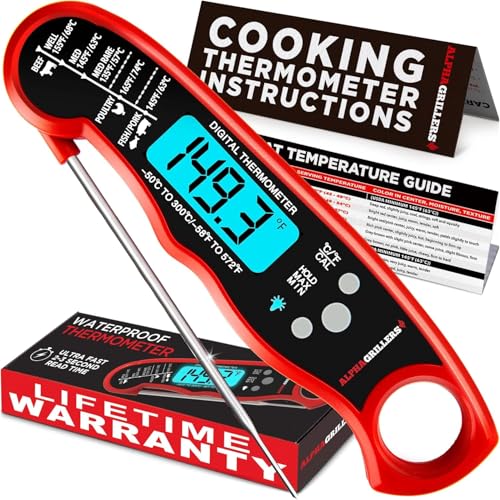
Alpha Grillers Meat Thermometer Digital – Instant Read Food Thermometer for Cooking & Grilling – Professional Kitchen Fathers Day Gift for Dad Men Him Husband
Best Overall
Alpha Grillers Meat Thermometer Digital – Instant Read Food Thermometer for Cooking & Grilling – Professional Kitchen Fathers Day Gift for Dad Men Him Husband
~$12.97
Price as of 2026-05-31

Instant Read Food Thermometer | Our instant read thermometer features a temperature probe and advanced, highly accurate technology with 1-2 seconds response time; Instructions, meat temperature chart, comes pre-calibrated for your convenience, and recalibrating feature if needed.…

Check Price →

2. ThermoWorks Thermapen ONE — Best for High-Volume Processing

Price: $95-105 | Accuracy: +/- 0.5 F | Read Time: 1 second | Range: -58 to 572 F | Waterproof: IP67

The Thermapen ONE is the professional standard for a reason. When you are processing multiple deer, hogs, or cattle and need to check dozens of cuts in a session, the 1-second read time adds up to real time savings. Its accuracy is rated at half a degree Fahrenheit, which is tighter than any other consumer-grade instant-read on the market.

The folding probe design protects the tip during storage and automatically powers on when you open it. The motion-sensing backlight activates when you pick it up, so it is always ready without fumbling for a button. It is the kind of thoughtful design that matters when your hands are covered in blood and fat during processing day.

The downside is the price. At roughly three times the cost of the ThermoPop 2, you are paying a premium for speed and accuracy that most homesteaders will not strictly need. But if you process more than a few animals per year or run a farm-to-table operation, this is the thermometer that pays for itself in confidence.

Pros

  • 1-second read time — fastest on the market
  • +/- 0.5 F accuracy, lab-grade precision
  • Auto-on when probe opens, auto-sleep when closed
  • Motion-sensing backlight
  • Built to last years of heavy use

Cons

  • $95+ price tag is steep for occasional use
  • No wireless or Bluetooth connectivity
  • Overkill if you only process a few animals a year
Ranch Approved Verdict: The gold standard in instant-read thermometers. Worth the investment if you regularly process livestock or run a farm-stand meat operation where food safety and speed are paramount.

Check Price on Amazon

3. SharpTemp-V Digital Veterinary Thermometer — Best for Livestock Health

Price: $18-24 | Accuracy: +/- 0.2 F | Read Time: 8-10 seconds | Range: 89.6 to 109.2 F | Probe Length: 5 inches

Every homesteader with livestock needs a reliable veterinary thermometer, and the SharpTemp-V is our top pick. The 5-inch flexible probe is long enough for cattle and horses while still working fine for goats, sheep, and pigs. The wide LCD display shows the reading clearly even in dim barn lighting, and the back of the unit prints normal temperature ranges for common livestock species — a genuine time-saver when you are trying to remember whether 103 F is normal for a goat (it is) or a horse (it is not).

Digital veterinary thermometers are dramatically faster than the old glass mercury models. The SharpTemp-V gives you a stable reading in 8-10 seconds with an audible beep, compared to 2-3 minutes for a mercury thermometer. When you are restraining a stressed 1,200-pound cow in a headgate, those extra minutes matter a lot.

The flexible probe tip is important for safety — rigid probes can injure an animal that shifts suddenly. At under $25, you should honestly own at least two of these: one in the barn medicine kit and one in the house for emergencies. They use standard LR41 button cell batteries that are cheap and widely available.

Pros

  • 5-inch flexible probe safe for large and small animals
  • Normal temp ranges printed on the back
  • 8-10 second read time with audible beep
  • Under $25 — affordable enough to keep spares
  • Last-reading memory recall

Cons

  • Not waterproof — clean carefully
  • Small button-cell batteries can be fiddly to replace
  • Only reads Fahrenheit (no Celsius toggle on some models)
Ranch Approved Verdict: The most practical veterinary thermometer for homestead use. Fast enough to reduce stress on both you and the animal, accurate enough for clinical decisions, and cheap enough to own multiples.

Check Price on Amazon

4. Luster Leaf 1625 Digital Soil Thermometer — Best for Garden Planning

Price: $15-20 | Probe Length: 8.75 inches | Range: -20 to 180 F | Power: LR44 battery (included)

Planting by calendar date is how you end up with rotted corn seed and stunted tomato transplants. Soil temperature is the actual trigger for when to plant, and the Luster Leaf 1625 makes checking it dead simple. The 8.75-inch stainless steel probe reaches well past planting depth for virtually every garden crop, and the digital display gives you a precise Fahrenheit reading within about a minute of insertion.

What sets this apart from cheaper soil thermometers is the included reference chart listing ideal soil temperatures for 26 common vegetables. Stick the probe in the ground at 8 AM (morning readings are more accurate than afternoon), check the display, and compare it to the chart. If your soil is at 55 F and you are trying to plant corn, wait another week. If it is at 65 F, go ahead and get those beans in.

The stainless steel probe is rugged enough to push into compacted garden soil without bending, and the protective sheath with a pocket clip means it rides along on morning chore rounds without getting lost. This is not a fancy tool — it does one job and does it well.

Pros

  • 8.75-inch probe reaches deep planting depth
  • Reference chart for 26 vegetable planting temps
  • Stainless steel probe handles compacted soil
  • Protective sheath with pocket clip
  • Battery included

Cons

  • Takes about 60 seconds for a stable reading
  • No backlight on the display
  • Fahrenheit only — no Celsius option
Ranch Approved Verdict: The smartest $15 you can spend on your garden. Takes the guesswork out of planting timing and pays for itself the first season you avoid replanting a failed crop.

Check Price on Amazon

5. GQF 3018 Incubator Thermometer/Hygrometer — Best for Hatching Eggs

Price: $28-35 | Temp Accuracy: +/- 0.5 F | Humidity Accuracy: +/- 3% RH | Probe Length: 4 inches | Reads: Dry bulb and wet bulb

If you hatch eggs, you already know that the built-in thermometers on most incubators are unreliable. The GQF 3018 is the standard recommendation in hatching communities for good reason: it reads both dry bulb temperature and wet bulb temperature simultaneously, giving you an accurate humidity reading without needing a separate hygrometer.

The 4-inch stem inserts through a small hole (5/32 inch) in the incubator wall, so you can read the temperature from outside without opening the lid and disrupting the environment. This matters more than most beginners realize — every time you crack that incubator lid, you drop the temperature and humidity, and the unit has to recover. Being able to monitor from outside reduces that disruption.

The wet-bulb wick system is old-school but proven. You attach the included wick to the sensor and keep the other end in the humidity pan. Wet bulb readings let you calculate actual relative humidity, which is more reliable than the electronic humidity sensors in cheaper combo units that drift over time.

One important note: calibrate this against a known-good thermometer before your first hatch. Most units are accurate out of the box, but a half-degree offset at 99.5 F can be the difference between a strong hatch and dead embryos at day 18.

Pros

  • Reads both temperature and humidity (wet bulb)
  • External reading through incubator wall
  • Wet bulb method is more reliable than electronic sensors
  • Widely recommended in hatching communities
  • No batteries needed — analog thermometer with digital-level accuracy

Cons

  • Requires a hole drilled in the incubator
  • Wet bulb wick needs occasional replacement
  • Not digital — analog display (but highly accurate)
  • Conversion chart needed to get RH% from wet bulb reading
Ranch Approved Verdict: The go-to incubator thermometer for serious hatchers. The wet-bulb system is more dependable than cheap digital hygrometers, and the external reading design means fewer lid openings during critical development stages.

Check Price on Amazon

6. ThermoPro TP65A Wireless Indoor/Outdoor Thermometer — Best for Barn and Coop Monitoring

Price: $22-30 | Range: -4 to 158 F | Humidity Range: 10-99% RH | Wireless Range: 200 feet | Sensors: Supports up to 3 remote

Knowing the temperature in your barn, chicken coop, or greenhouse without walking out there in the dark is genuinely useful. The ThermoPro TP65A uses a dedicated radio frequency (not WiFi or Bluetooth) to send temperature and humidity data from a weatherproof outdoor sensor to a large, backlit indoor display. The 200-foot range covers most homestead layouts.

The base station supports up to 3 wireless sensors (one included, extras sold separately), so you can monitor the barn, chicken coop, and greenhouse from a single display in the kitchen. Each sensor transmits temperature and humidity readings that update every 60 seconds. The touchscreen base shows current readings plus 24-hour highs and lows for each sensor.

The outdoor sensors are weather-resistant and run on 2 AAA batteries that last about a year. They mount on any flat surface or hang from a screw. We particularly like using these for hay barn fire monitoring — if the temperature inside a hay barn spikes unexpectedly, you want to know about it before you have a barn fire.

The one limitation is the lack of alerts. The TP65A shows the readings but does not sound an alarm if temperatures drop below freezing or spike above a threshold. For alert-based monitoring, you would need to step up to a WiFi-connected weather station. But for basic awareness at a glance, this unit does the job well at a very reasonable price.

Pros

  • 200-foot wireless range covers most homesteads
  • Supports up to 3 sensors for multi-location monitoring
  • Large, backlit touchscreen display
  • Records 24-hour high/low temperatures
  • No WiFi or app required — just works

Cons

  • No temperature alerts or alarms
  • 200-foot range may not reach distant outbuildings
  • Extra sensors cost $10-15 each
  • No data logging or phone connectivity
Ranch Approved Verdict: The easiest way to keep tabs on barn and coop temperatures without leaving the house. No apps, no WiFi, no complications — just reliable readings from across the property.

Check Price on Amazon

7. ThermoPro TP49 Mini Digital Hygrometer/Thermometer — Best Budget Pick

Price: $8-12 | Range: -4 to 158 F | Humidity Range: 20-99% RH | Accuracy: +/- 1.8 F | Power: CR2032 coin cell

Sometimes you just need a cheap, reliable thermometer that you can stick in a chicken coop, tack (check price) room, or root cellar and forget about until you need to check it. The ThermoPro TP49 is that thermometer. At under $10 (often sold in multi-packs for even less), you can afford to scatter these across every outbuilding on your property.

The display is surprisingly clear for such a small, inexpensive unit. It shows current temperature, current humidity, and a comfort-level indicator (dry, comfortable, or wet). There is no backlight, which is a trade-off for the coin-cell battery lasting up to 18 months. The magnetic back and fold-out stand give you flexible mounting options — stick it to a metal beam in the barn, set it on a shelf in the root cellar, or hang it from a nail in the coop.

Accuracy is within 1.8 F for temperature and 5% for humidity, which is perfectly adequate for ambient monitoring. You are not using this for clinical decisions or food safety — you are using it to answer questions like "Is it below freezing in the coop?" or "Is the humidity in the tack room high enough to rust my tools?"

We keep three of these: one in the chicken coop, one in the hay barn, and one in the root cellar. At $8 each, the total investment is less than a single premium thermometer, and they have all been running for over a year on the original batteries.

Pros

  • Under $10 — buy several for every outbuilding
  • 18-month battery life on a single coin cell
  • Magnetic back, fold-out stand, and hanging hole
  • Shows both temperature and humidity
  • Compact enough to tuck anywhere

Cons

  • No backlight — hard to read in the dark
  • Must walk to the unit to check readings
  • Humidity accuracy is only +/- 5%
  • No alerts, alarms, or data logging
Ranch Approved Verdict: The best thermometer investment per dollar on this list. Buy a 3-pack and monitor every outbuilding on your homestead for the cost of a fast-food meal.

Check Price on Amazon

8. Non-Contact Veterinary Infrared Thermometer — Best for Stress-Free Animal Checks

Price: $25-35 | Accuracy: +/- 0.5 F | Read Time: 1 second | Suitable for: Cattle, horses, pigs, sheep, dogs

A rectal thermometer is the clinical gold standard for livestock temperature, but a non-contact infrared thermometer earns its place as a triage tool. Walking a pen at sorting time and scanning each animal's ear in about one second lets you flag animals running hot before you ever reach for a halter. A cow reading 3-4 F above her pen-mates is worth pulling out for a definitive rectal check — but you would not have noticed her otherwise.

These are also useful for animals that will not stand still for restraint — a newly arrived horse that is still stressed from transport, a pig that has not been handled much, a goat that considers the entire enterprise beneath her dignity. You can get a working temperature without escalating the situation.

Look for models specifically calibrated for livestock rather than repurposed human forehead thermometers. Cattle normal temperature (101.5-103.5 F) is higher than the human range that most non-contact thermometers are optimized for. Veterinary-rated models include livestock-specific reference ranges in the manual.

Pros

  • 1-second reading with no animal contact required
  • Scan a pen of 20 animals in under a minute
  • Useful for stressed or difficult-to-handle animals
  • Calibrated for livestock temperature ranges

Cons

  • Less accurate than rectal — for triage, not clinical decisions
  • Coat length and wet fur can affect surface readings
  • Follow up any flagged animal with a rectal reading
Ranch Approved Verdict: A useful secondary tool for quickly scanning a herd. Not a replacement for your rectal thermometer, but a smart way to identify which animals need one.

Check Price on Amazon

9. MOCREO WiFi Freezer Thermometer — Best for Vaccine and Medication Storage

Price: $35-45 | Accuracy: +/- 0.9 F | Range: -40 to 221 F | Alerts: App + email | Subscription: None

If you store vaccines, antibiotics, or reproductive biologicals on your homestead, you need to know the moment your refrigerator or freezer drifts out of safe range — not the next morning when you open the door. The MOCREO WiFi thermometer connects to your home network and sends app and email alerts the instant the temperature goes outside your set limits. No subscription fees, no monthly charges.

The probe uses a thin flat cable that slides through refrigerator door seals without breaking the cold seal. You can set custom high and low alarms — typically 35-46 F for standard vaccine refrigeration, -4 F or colder for frozen semen and certain biologicals. If the power goes out at 2 AM, you will know within minutes rather than discovering ruined product at morning chores.

The MOCREO also logs data and exports to CSV — useful for demonstrating proper cold chain management for regulatory compliance or documenting a temperature excursion for an insurance claim. Two sensors included at under $40 total. One failed compressor's worth of ruined vaccines costs more than ten of these units.

Pros

  • Instant app and email alerts — no subscription required
  • Probe slides through refrigerator seal without gap
  • Data logging with CSV export
  • Two sensors included
  • 2-year battery life on sensor

Cons

  • Requires WiFi — no cell signal backup
  • App setup required before alerts work
  • Alert delivery depends on internet being up
Ranch Approved Verdict: Essential for anyone storing vaccines or biologicals. The alert system pays for itself the first time it catches a power outage before a refrigerator full of vaccines is ruined.

Check Price on Amazon

What to Look For in a Homestead Thermometer

With so many options on the market, here are the features that actually matter for homestead use.

Speed

When you are checking a sick calf or processing meat, you want readings fast. Instant-read meat thermometers should read in under 3 seconds. Veterinary thermometers that read in under 15 seconds are worth the premium over models that take 30-60 seconds — less time restraining a stressed animal means less risk for both of you.

Accuracy

For food safety and veterinary use, accuracy within 1-2 F is important. For ambient monitoring (barn temp, coop temp), accuracy within 2-3 F is plenty. Do not overpay for laboratory-grade accuracy in applications where it does not matter.

Durability

Homestead tools get dropped, rained on, and shoved in pockets with fencing staples. Look for waterproof ratings (IP67 or better) on meat thermometers and weather-resistant housings on outdoor sensors. Stainless steel probes outlast chrome-plated ones.

Battery Life

The best thermometer is useless with dead batteries. Look for models that get 12+ months on standard batteries (AAA, AA, or coin cells). Avoid rechargeable-only models for barn use — you do not want to remember to charge a thermometer on the same night your cow gets sick.

Readability

Large displays and backlights matter on a homestead. You will be checking readings in dim barns at 5 AM, in bright sunshine at noon, and through fogged-up safety glasses during processing. A display you cannot read quickly is a display that wastes your time.

Frequently Asked Questions

Can I use a meat thermometer to check soil temperature?

Technically yes, but it is not ideal. Meat thermometer probes are typically 3-4 inches long, which may not reach planting depth in garden beds. They are also calibrated for a higher temperature range and may not be as accurate at the 40-70 F range that matters for soil. A dedicated soil thermometer with an 8-inch probe costs $15 and does a better job.

How often should I check my livestock's temperature?

Take a baseline temperature when an animal is healthy so you know what is normal for that individual. Then check any time an animal seems off — not eating, lethargic, nasal discharge, isolating from the herd. During calving or foaling season, a twice-daily check on animals close to delivery is good practice. Always check before calling the vet so you can report an actual number.

Do I need a WiFi-connected weather station?

For most homesteads, no. A basic wireless thermometer with remote sensors gives you the same readings without the complexity of WiFi setup, app accounts, and cloud service subscriptions. WiFi stations are nice if you want to check temperatures while away from the property, but they add cost and failure points (internet outage = no data). Start with a simple wireless unit and upgrade later if you find you need remote access.

How accurate are the built-in thermometers on incubators?

In our experience and based on widespread reports from hatching communities, built-in incubator thermometers are often off by 2-5 F. That is enough to ruin an entire hatch. Always verify with an independent thermometer before loading eggs. Run the incubator empty for 24 hours with your standalone thermometer inside, and adjust the incubator's thermostat until the independent reading is correct.

What is the most important thermometer to buy first?

If you have livestock, start with a veterinary thermometer — it is the cheapest item on this list and the most critical for animal health decisions. If you do not have livestock but garden and process your own food, start with a good instant-read meat thermometer. The ThermoPop 2 covers the most use cases for the least money.

The Bottom Line

You do not need to spend hundreds of dollars to properly equip your homestead with thermometers. Our full recommended kit — a ThermoPop 2 for meat processing, a SharpTemp-V for livestock, a Luster Leaf for soil, and a few ThermoPro TP49 units for ambient monitoring — runs about $80 total. That is less than a single vet call, less than replanting a failed garden, and far less than a foodborne illness from undercooked meat.

Digital thermometers are not a luxury on a homestead. They are basic diagnostic tools that help you make faster, better decisions about animal health, food safety, and planting timing. The old-timers who say they can tell temperature by feel are not wrong — experience counts for a lot. But a $20 thermometer removes the guessing, and on a homestead, guessing wrong can be expensive.

Start with whatever category matters most to your operation right now, and build out from there. Every thermometer on this list will pay for itself the first time it helps you catch a fever early, plant at the right time, or pull a brisket at exactly the right temp.

Ranch Approved
Tested and reviewed by ranchers who actually use this gear.
Published: March 14, 2026 Updated: May 31, 2026

Ranch Approved is reader-supported. When you buy through links on our site, we may earn an affiliate commission at no extra cost to you. How we test. As an Amazon Associate I earn from qualifying purchases.

Disclosure: Links in this section are affiliate links. We may earn a commission at no extra cost to you.

Are Digital Thermometers Actually Worth It on a Homestead?

If you have been running a homestead for any length of time, you already know that temperature controls almost everything. Whether your seeds germinate or rot in the ground. Whether that side of beef you just processed is safe to eat. Whether your broody hen's eggs hatch or quit at day 18. Whether that calf with the runny nose has a low-grade issue or a full-blown emergency.

The short answer is yes, digital thermometers are absolutely worth it. The longer answer is that you probably need more than one, because a single thermometer cannot do everything a working homestead demands.

A good instant-read meat thermometer will not help you check soil temperature at planting depth. A livestock rectal thermometer is useless for monitoring your incubator overnight. And that little weather station on your porch has no business near a processing table.

We put together this guide after hearing the same question come up repeatedly in homesteading communities: "Do I really need a digital thermometer, or is analog fine?" Our take: analog thermometers still have their place (they do not need batteries, for one), but digital models are faster, more accurate, and in some cases can send readings to your phone while you are out doing chores. When you are checking a sick animal at 2 AM or trying to nail the internal temp on a whole hog, those advantages matter.

Below, we cover 7 digital thermometers across every category a homesteader might need, from livestock health to meat processing to egg incubation. Every pick is a real product you can buy today, and we have included realistic pricing, key specs, and honest pros and cons for each one.

Alpha Grillers Meat Thermometer Digital – Instant Read Food Thermometer for Cooking & Grilling – Professional Kitchen Fathers Day Gift for Dad Men Him Husband
Best Overall
Alpha Grillers Meat Thermometer Digital – Instant Read Food Thermometer for Cooking & Grilling – Professional Kitchen Fathers Day Gift for Dad Men Him Husband
~$12.97
Price as of 2026-05-31

Instant Read Food Thermometer | Our instant read thermometer features a temperature probe and advanced, highly accurate technology with 1-2 seconds response time; Instructions, meat temperature chart, comes pre-calibrated for your convenience, and recalibrating feature if needed.…

Check Price →

2. ThermoWorks Thermapen ONE — Best for High-Volume Processing

Price: $95-105 | Accuracy: +/- 0.5 F | Read Time: 1 second | Range: -58 to 572 F | Waterproof: IP67

The Thermapen ONE is the professional standard for a reason. When you are processing multiple deer, hogs, or cattle and need to check dozens of cuts in a session, the 1-second read time adds up to real time savings. Its accuracy is rated at half a degree Fahrenheit, which is tighter than any other consumer-grade instant-read on the market.

The folding probe design protects the tip during storage and automatically powers on when you open it. The motion-sensing backlight activates when you pick it up, so it is always ready without fumbling for a button. It is the kind of thoughtful design that matters when your hands are covered in blood and fat during processing day.

The downside is the price. At roughly three times the cost of the ThermoPop 2, you are paying a premium for speed and accuracy that most homesteaders will not strictly need. But if you process more than a few animals per year or run a farm-to-table operation, this is the thermometer that pays for itself in confidence.

Pros

  • 1-second read time — fastest on the market
  • +/- 0.5 F accuracy, lab-grade precision
  • Auto-on when probe opens, auto-sleep when closed
  • Motion-sensing backlight
  • Built to last years of heavy use

Cons

  • $95+ price tag is steep for occasional use
  • No wireless or Bluetooth connectivity
  • Overkill if you only process a few animals a year
Ranch Approved Verdict: The gold standard in instant-read thermometers. Worth the investment if you regularly process livestock or run a farm-stand meat operation where food safety and speed are paramount.

Check Price on Amazon

3. SharpTemp-V Digital Veterinary Thermometer — Best for Livestock Health

Price: $18-24 | Accuracy: +/- 0.2 F | Read Time: 8-10 seconds | Range: 89.6 to 109.2 F | Probe Length: 5 inches

Every homesteader with livestock needs a reliable veterinary thermometer, and the SharpTemp-V is our top pick. The 5-inch flexible probe is long enough for cattle and horses while still working fine for goats, sheep, and pigs. The wide LCD display shows the reading clearly even in dim barn lighting, and the back of the unit prints normal temperature ranges for common livestock species — a genuine time-saver when you are trying to remember whether 103 F is normal for a goat (it is) or a horse (it is not).

Digital veterinary thermometers are dramatically faster than the old glass mercury models. The SharpTemp-V gives you a stable reading in 8-10 seconds with an audible beep, compared to 2-3 minutes for a mercury thermometer. When you are restraining a stressed 1,200-pound cow in a headgate, those extra minutes matter a lot.

The flexible probe tip is important for safety — rigid probes can injure an animal that shifts suddenly. At under $25, you should honestly own at least two of these: one in the barn medicine kit and one in the house for emergencies. They use standard LR41 button cell batteries that are cheap and widely available.

Pros

  • 5-inch flexible probe safe for large and small animals
  • Normal temp ranges printed on the back
  • 8-10 second read time with audible beep
  • Under $25 — affordable enough to keep spares
  • Last-reading memory recall

Cons

  • Not waterproof — clean carefully
  • Small button-cell batteries can be fiddly to replace
  • Only reads Fahrenheit (no Celsius toggle on some models)
Ranch Approved Verdict: The most practical veterinary thermometer for homestead use. Fast enough to reduce stress on both you and the animal, accurate enough for clinical decisions, and cheap enough to own multiples.

Check Price on Amazon

4. Luster Leaf 1625 Digital Soil Thermometer — Best for Garden Planning

Price: $15-20 | Probe Length: 8.75 inches | Range: -20 to 180 F | Power: LR44 battery (included)

Planting by calendar date is how you end up with rotted corn seed and stunted tomato transplants. Soil temperature is the actual trigger for when to plant, and the Luster Leaf 1625 makes checking it dead simple. The 8.75-inch stainless steel probe reaches well past planting depth for virtually every garden crop, and the digital display gives you a precise Fahrenheit reading within about a minute of insertion.

What sets this apart from cheaper soil thermometers is the included reference chart listing ideal soil temperatures for 26 common vegetables. Stick the probe in the ground at 8 AM (morning readings are more accurate than afternoon), check the display, and compare it to the chart. If your soil is at 55 F and you are trying to plant corn, wait another week. If it is at 65 F, go ahead and get those beans in.

The stainless steel probe is rugged enough to push into compacted garden soil without bending, and the protective sheath with a pocket clip means it rides along on morning chore rounds without getting lost. This is not a fancy tool — it does one job and does it well.

Pros

  • 8.75-inch probe reaches deep planting depth
  • Reference chart for 26 vegetable planting temps
  • Stainless steel probe handles compacted soil
  • Protective sheath with pocket clip
  • Battery included

Cons

  • Takes about 60 seconds for a stable reading
  • No backlight on the display
  • Fahrenheit only — no Celsius option
Ranch Approved Verdict: The smartest $15 you can spend on your garden. Takes the guesswork out of planting timing and pays for itself the first season you avoid replanting a failed crop.

Check Price on Amazon

5. GQF 3018 Incubator Thermometer/Hygrometer — Best for Hatching Eggs

Price: $28-35 | Temp Accuracy: +/- 0.5 F | Humidity Accuracy: +/- 3% RH | Probe Length: 4 inches | Reads: Dry bulb and wet bulb

If you hatch eggs, you already know that the built-in thermometers on most incubators are unreliable. The GQF 3018 is the standard recommendation in hatching communities for good reason: it reads both dry bulb temperature and wet bulb temperature simultaneously, giving you an accurate humidity reading without needing a separate hygrometer.

The 4-inch stem inserts through a small hole (5/32 inch) in the incubator wall, so you can read the temperature from outside without opening the lid and disrupting the environment. This matters more than most beginners realize — every time you crack that incubator lid, you drop the temperature and humidity, and the unit has to recover. Being able to monitor from outside reduces that disruption.

The wet-bulb wick system is old-school but proven. You attach the included wick to the sensor and keep the other end in the humidity pan. Wet bulb readings let you calculate actual relative humidity, which is more reliable than the electronic humidity sensors in cheaper combo units that drift over time.

One important note: calibrate this against a known-good thermometer before your first hatch. Most units are accurate out of the box, but a half-degree offset at 99.5 F can be the difference between a strong hatch and dead embryos at day 18.

Pros

  • Reads both temperature and humidity (wet bulb)
  • External reading through incubator wall
  • Wet bulb method is more reliable than electronic sensors
  • Widely recommended in hatching communities
  • No batteries needed — analog thermometer with digital-level accuracy

Cons

  • Requires a hole drilled in the incubator
  • Wet bulb wick needs occasional replacement
  • Not digital — analog display (but highly accurate)
  • Conversion chart needed to get RH% from wet bulb reading
Ranch Approved Verdict: The go-to incubator thermometer for serious hatchers. The wet-bulb system is more dependable than cheap digital hygrometers, and the external reading design means fewer lid openings during critical development stages.

Check Price on Amazon

6. ThermoPro TP65A Wireless Indoor/Outdoor Thermometer — Best for Barn and Coop Monitoring

Price: $22-30 | Range: -4 to 158 F | Humidity Range: 10-99% RH | Wireless Range: 200 feet | Sensors: Supports up to 3 remote

Knowing the temperature in your barn, chicken coop, or greenhouse without walking out there in the dark is genuinely useful. The ThermoPro TP65A uses a dedicated radio frequency (not WiFi or Bluetooth) to send temperature and humidity data from a weatherproof outdoor sensor to a large, backlit indoor display. The 200-foot range covers most homestead layouts.

The base station supports up to 3 wireless sensors (one included, extras sold separately), so you can monitor the barn, chicken coop, and greenhouse from a single display in the kitchen. Each sensor transmits temperature and humidity readings that update every 60 seconds. The touchscreen base shows current readings plus 24-hour highs and lows for each sensor.

The outdoor sensors are weather-resistant and run on 2 AAA batteries that last about a year. They mount on any flat surface or hang from a screw. We particularly like using these for hay barn fire monitoring — if the temperature inside a hay barn spikes unexpectedly, you want to know about it before you have a barn fire.

The one limitation is the lack of alerts. The TP65A shows the readings but does not sound an alarm if temperatures drop below freezing or spike above a threshold. For alert-based monitoring, you would need to step up to a WiFi-connected weather station. But for basic awareness at a glance, this unit does the job well at a very reasonable price.

Pros

  • 200-foot wireless range covers most homesteads
  • Supports up to 3 sensors for multi-location monitoring
  • Large, backlit touchscreen display
  • Records 24-hour high/low temperatures
  • No WiFi or app required — just works

Cons

  • No temperature alerts or alarms
  • 200-foot range may not reach distant outbuildings
  • Extra sensors cost $10-15 each
  • No data logging or phone connectivity
Ranch Approved Verdict: The easiest way to keep tabs on barn and coop temperatures without leaving the house. No apps, no WiFi, no complications — just reliable readings from across the property.

Check Price on Amazon

7. ThermoPro TP49 Mini Digital Hygrometer/Thermometer — Best Budget Pick

Price: $8-12 | Range: -4 to 158 F | Humidity Range: 20-99% RH | Accuracy: +/- 1.8 F | Power: CR2032 coin cell

Sometimes you just need a cheap, reliable thermometer that you can stick in a chicken coop, tack (check price) room, or root cellar and forget about until you need to check it. The ThermoPro TP49 is that thermometer. At under $10 (often sold in multi-packs for even less), you can afford to scatter these across every outbuilding on your property.

The display is surprisingly clear for such a small, inexpensive unit. It shows current temperature, current humidity, and a comfort-level indicator (dry, comfortable, or wet). There is no backlight, which is a trade-off for the coin-cell battery lasting up to 18 months. The magnetic back and fold-out stand give you flexible mounting options — stick it to a metal beam in the barn, set it on a shelf in the root cellar, or hang it from a nail in the coop.

Accuracy is within 1.8 F for temperature and 5% for humidity, which is perfectly adequate for ambient monitoring. You are not using this for clinical decisions or food safety — you are using it to answer questions like "Is it below freezing in the coop?" or "Is the humidity in the tack room high enough to rust my tools?"

We keep three of these: one in the chicken coop, one in the hay barn, and one in the root cellar. At $8 each, the total investment is less than a single premium thermometer, and they have all been running for over a year on the original batteries.

Pros

  • Under $10 — buy several for every outbuilding
  • 18-month battery life on a single coin cell
  • Magnetic back, fold-out stand, and hanging hole
  • Shows both temperature and humidity
  • Compact enough to tuck anywhere

Cons

  • No backlight — hard to read in the dark
  • Must walk to the unit to check readings
  • Humidity accuracy is only +/- 5%
  • No alerts, alarms, or data logging
Ranch Approved Verdict: The best thermometer investment per dollar on this list. Buy a 3-pack and monitor every outbuilding on your homestead for the cost of a fast-food meal.

Check Price on Amazon

8. Non-Contact Veterinary Infrared Thermometer — Best for Stress-Free Animal Checks

Price: $25-35 | Accuracy: +/- 0.5 F | Read Time: 1 second | Suitable for: Cattle, horses, pigs, sheep, dogs

A rectal thermometer is the clinical gold standard for livestock temperature, but a non-contact infrared thermometer earns its place as a triage tool. Walking a pen at sorting time and scanning each animal's ear in about one second lets you flag animals running hot before you ever reach for a halter. A cow reading 3-4 F above her pen-mates is worth pulling out for a definitive rectal check — but you would not have noticed her otherwise.

These are also useful for animals that will not stand still for restraint — a newly arrived horse that is still stressed from transport, a pig that has not been handled much, a goat that considers the entire enterprise beneath her dignity. You can get a working temperature without escalating the situation.

Look for models specifically calibrated for livestock rather than repurposed human forehead thermometers. Cattle normal temperature (101.5-103.5 F) is higher than the human range that most non-contact thermometers are optimized for. Veterinary-rated models include livestock-specific reference ranges in the manual.

Pros

  • 1-second reading with no animal contact required
  • Scan a pen of 20 animals in under a minute
  • Useful for stressed or difficult-to-handle animals
  • Calibrated for livestock temperature ranges

Cons

  • Less accurate than rectal — for triage, not clinical decisions
  • Coat length and wet fur can affect surface readings
  • Follow up any flagged animal with a rectal reading
Ranch Approved Verdict: A useful secondary tool for quickly scanning a herd. Not a replacement for your rectal thermometer, but a smart way to identify which animals need one.

Check Price on Amazon

9. MOCREO WiFi Freezer Thermometer — Best for Vaccine and Medication Storage

Price: $35-45 | Accuracy: +/- 0.9 F | Range: -40 to 221 F | Alerts: App + email | Subscription: None

If you store vaccines, antibiotics, or reproductive biologicals on your homestead, you need to know the moment your refrigerator or freezer drifts out of safe range — not the next morning when you open the door. The MOCREO WiFi thermometer connects to your home network and sends app and email alerts the instant the temperature goes outside your set limits. No subscription fees, no monthly charges.

The probe uses a thin flat cable that slides through refrigerator door seals without breaking the cold seal. You can set custom high and low alarms — typically 35-46 F for standard vaccine refrigeration, -4 F or colder for frozen semen and certain biologicals. If the power goes out at 2 AM, you will know within minutes rather than discovering ruined product at morning chores.

The MOCREO also logs data and exports to CSV — useful for demonstrating proper cold chain management for regulatory compliance or documenting a temperature excursion for an insurance claim. Two sensors included at under $40 total. One failed compressor's worth of ruined vaccines costs more than ten of these units.

Pros

  • Instant app and email alerts — no subscription required
  • Probe slides through refrigerator seal without gap
  • Data logging with CSV export
  • Two sensors included
  • 2-year battery life on sensor

Cons

  • Requires WiFi — no cell signal backup
  • App setup required before alerts work
  • Alert delivery depends on internet being up
Ranch Approved Verdict: Essential for anyone storing vaccines or biologicals. The alert system pays for itself the first time it catches a power outage before a refrigerator full of vaccines is ruined.

Check Price on Amazon

What to Look For in a Homestead Thermometer

With so many options on the market, here are the features that actually matter for homestead use.

Speed

When you are checking a sick calf or processing meat, you want readings fast. Instant-read meat thermometers should read in under 3 seconds. Veterinary thermometers that read in under 15 seconds are worth the premium over models that take 30-60 seconds — less time restraining a stressed animal means less risk for both of you.

Accuracy

For food safety and veterinary use, accuracy within 1-2 F is important. For ambient monitoring (barn temp, coop temp), accuracy within 2-3 F is plenty. Do not overpay for laboratory-grade accuracy in applications where it does not matter.

Durability

Homestead tools get dropped, rained on, and shoved in pockets with fencing staples. Look for waterproof ratings (IP67 or better) on meat thermometers and weather-resistant housings on outdoor sensors. Stainless steel probes outlast chrome-plated ones.

Battery Life

The best thermometer is useless with dead batteries. Look for models that get 12+ months on standard batteries (AAA, AA, or coin cells). Avoid rechargeable-only models for barn use — you do not want to remember to charge a thermometer on the same night your cow gets sick.

Readability

Large displays and backlights matter on a homestead. You will be checking readings in dim barns at 5 AM, in bright sunshine at noon, and through fogged-up safety glasses during processing. A display you cannot read quickly is a display that wastes your time.

Frequently Asked Questions

Can I use a meat thermometer to check soil temperature?

Technically yes, but it is not ideal. Meat thermometer probes are typically 3-4 inches long, which may not reach planting depth in garden beds. They are also calibrated for a higher temperature range and may not be as accurate at the 40-70 F range that matters for soil. A dedicated soil thermometer with an 8-inch probe costs $15 and does a better job.

How often should I check my livestock's temperature?

Take a baseline temperature when an animal is healthy so you know what is normal for that individual. Then check any time an animal seems off — not eating, lethargic, nasal discharge, isolating from the herd. During calving or foaling season, a twice-daily check on animals close to delivery is good practice. Always check before calling the vet so you can report an actual number.

Do I need a WiFi-connected weather station?

For most homesteads, no. A basic wireless thermometer with remote sensors gives you the same readings without the complexity of WiFi setup, app accounts, and cloud service subscriptions. WiFi stations are nice if you want to check temperatures while away from the property, but they add cost and failure points (internet outage = no data). Start with a simple wireless unit and upgrade later if you find you need remote access.

How accurate are the built-in thermometers on incubators?

In our experience and based on widespread reports from hatching communities, built-in incubator thermometers are often off by 2-5 F. That is enough to ruin an entire hatch. Always verify with an independent thermometer before loading eggs. Run the incubator empty for 24 hours with your standalone thermometer inside, and adjust the incubator's thermostat until the independent reading is correct.

What is the most important thermometer to buy first?

If you have livestock, start with a veterinary thermometer — it is the cheapest item on this list and the most critical for animal health decisions. If you do not have livestock but garden and process your own food, start with a good instant-read meat thermometer. The ThermoPop 2 covers the most use cases for the least money.

The Bottom Line

You do not need to spend hundreds of dollars to properly equip your homestead with thermometers. Our full recommended kit — a ThermoPop 2 for meat processing, a SharpTemp-V for livestock, a Luster Leaf for soil, and a few ThermoPro TP49 units for ambient monitoring — runs about $80 total. That is less than a single vet call, less than replanting a failed garden, and far less than a foodborne illness from undercooked meat.

Digital thermometers are not a luxury on a homestead. They are basic diagnostic tools that help you make faster, better decisions about animal health, food safety, and planting timing. The old-timers who say they can tell temperature by feel are not wrong — experience counts for a lot. But a $20 thermometer removes the guessing, and on a homestead, guessing wrong can be expensive.

Start with whatever category matters most to your operation right now, and build out from there. Every thermometer on this list will pay for itself the first time it helps you catch a fever early, plant at the right time, or pull a brisket at exactly the right temp.

Get the Ranch Approved Gear Guide

Our best picks, seasonal recommendations, and honest reviews — delivered straight to your inbox.