Ranch Approved is reader-supported. When you buy through links on our site, we may earn an affiliate commission at no extra cost to you. How we research.
If you have ever watched a cattle producer set up a rotational grazing paddock, it looks almost effortless. They hop off a side-by-side, step in a few fiberglass pigtail posts, unspool a single strand of polywire at chest height from a geared reel, and clip on a solar charger. In less than fifteen minutes, twenty head of steers are happily grazing behind a single wire.
Try that exact same stunt with sheep or goats, and you will be spending your evening chasing livestock through your neighbor’s soybean field. Small ruminants are an entirely different animal. A mature ewe wrapped in two inches of lanolin-rich fleece is virtually immune to a casual electric brush; she won’t even blink unless the pulse hits her nose. Goats, on the other hand, are four-legged acrobats that will duck under a chest-high wire, leap over a waist-high wire, or squeeze right between strands. Add relentless nighttime predator pressure from coyotes, feral dogs, and bobcats, and temporary fencing for sheep and goats becomes a serious operational challenge.
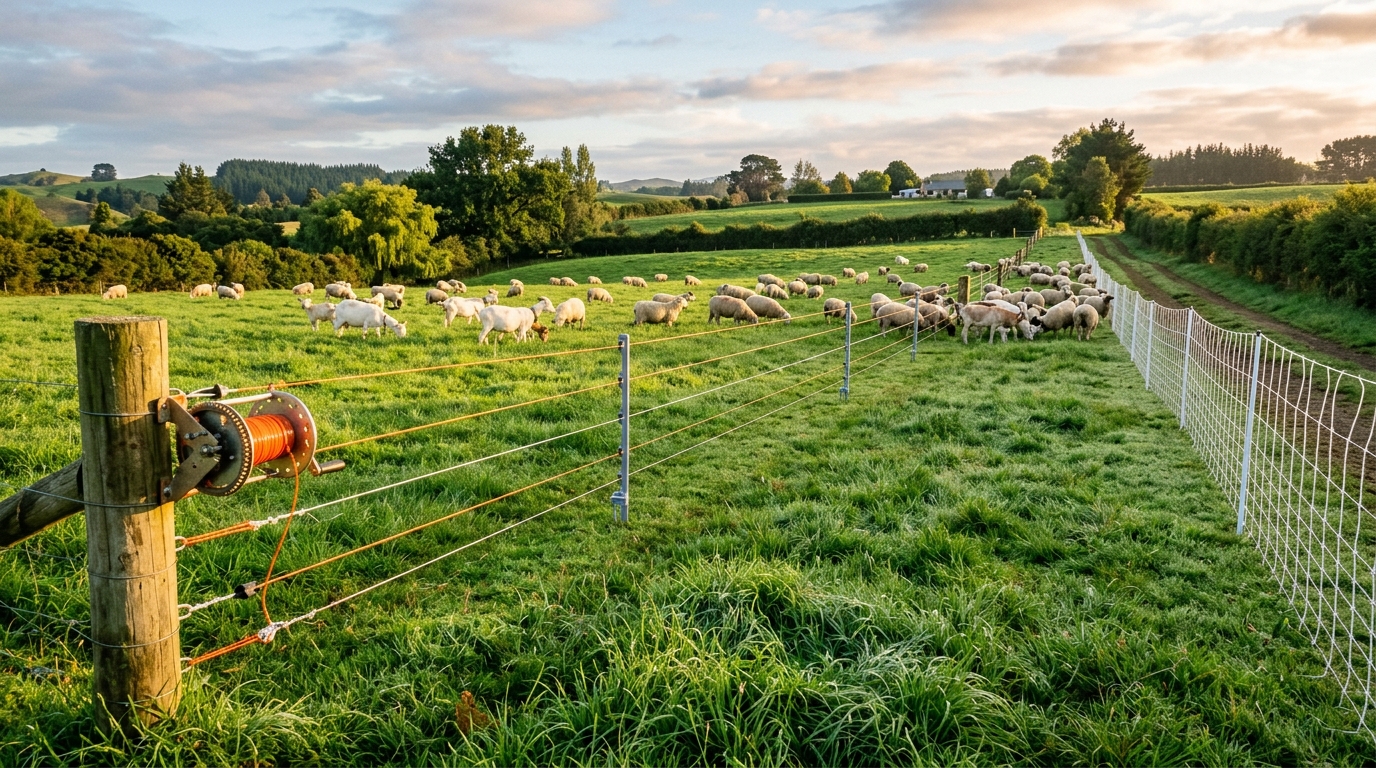
When setting up portable rotational paddocks for small ruminants, graziers inevitably face a fundamental crossroads: prefabricated portable electric netting or multi-strand step-in polywire? Both systems have fiercely loyal advocates on homesteading forums and working ranches, but they behave radically differently in the dirt. One delivers impenetrable predator defense at the cost of higher expense and brush snags; the other offers dirt-cheap versatility and lightning-fast winter resilience, but demands multi-wire labor and an existing predator barrier.
Below is our comprehensive, field-tested head-to-head breakdown comparing setup times, cost per linear foot, vegetation shorting, and livestock containment so you can invest in the exact system that fits your pasture, herd, and terrain.
Fast Verdict & Quick Picks
The benchmark in small ruminant containment and predator exclusion. Features 10 horizontal strands with ultra-conductive mixed-metal filaments and rigid 12-inch vertical stays that eliminate mid-span sag. If you need a perimeter fence that stops coyotes and jumpy goats in open pastures, nothing touches it.
Woven with 9 mixed-metal conductors (including tinned copper filaments) delivering 40 times the conductivity of standard stainless polywire. Paired with a heavy-duty 3:1 geared reel, it lets you string multi-strand cross-fences across brushy, wooded, or rocky acreage in record time without voltage drop.
Pumping out 3.0 stored joules, the P30 has the electrical muscle required to overcome the capacitive coupling of multiple net rolls while running equally well on AC wall outlets or a 12V pasture battery. It delivers the 5,000V+ punch needed to shock through thick wool.
Head-to-Head Comparison: Netting vs. Multi-Strand Polywire
| Performance Metric | Prefabricated Electric Netting (42”) | Multi-Strand Polywire (4–5 Strands) | The Ranch Approved Verdict |
|---|---|---|---|
| Cost per 164 Linear Feet | $170–$205 ($1.05–$1.25 / ft) | $35–$55 ($0.21–$0.34 / ft) | Polywire wins decisively on initial capital cost |
| Setup Time (per 164 ft run) | 8–12 minutes (one pass, all 10 strands) | 20–30 minutes (walking the line 4–5 times) | Netting wins on labor efficiency per linear foot |
| Coyote & Dog Predator Defense | Outstanding (physical 6x6” live grid) | Poor to Negligible (predators leap or slide through) | Netting is mandatory in high-predator zones |
| Brush & Bramble Terrain | Terrible (snags on briars, cedar, and rocks) | Excellent (threads cleanly through timber and brush) | Polywire dominates silvopasture and rough brush |
| Snow Load & Winter Durability | Poor (heavy snow flattens mesh to ground) | Excellent (individual strands slice through snow) | Polywire wins for deep winter grazing |
| Entanglement & Horn Safety | Moderate risk (requires strict herd training) | Near Zero (no squares for horns to wedge into) | Polywire is safer for untrained horned stock |
| Energizer Output Required | High (0.25+ Joules per 164 ft roll) | Low (0.05–0.10 Joules per 164 ft run) | Polywire runs cleanly on smaller chargers |
The Cattle Polywire Myth: Why Small Ruminants Demand 4 to 5 Strands
Before comparing systems, we must address the most dangerous myth in rotational grazing: “You can control sheep and goats with two strands of polywire.”
Every year, well-meaning homesteaders watch videos of cattle graziers strip-grazing pastures with two thin wires at 18 inches and 32 inches. They set up the same two wires for a mixed flock of hair sheep and Boer goats, turn them out, and watch in disbelief as the animals graze directly under the bottom strand or casually hop over the top wire. Within two days, the flock is completely wild, and coyotes have picked off two spring lambs.
Cattle have high mass, thin hair coats, wet muzzles that lead their movement, and a strong natural herd instinct. Sheep and goats do not. To contain sheep and goats behind individual strands of polywire without a physical net, you must string a minimum of four to five tightly spaced horizontal strands:
- Strand 1 (6 to 8 inches off dirt): Essential to stop lambs, kids, and predators from sliding beneath the fence while grazing on their knees.
- Strand 2 (12 to 14 inches): Intercepts muzzles and shoulders when stock lower their heads to reach green grass outside the paddock.
- Strand 3 (18 to 20 inches): Targets the chest and neck of mature sheep and medium goats.
- Strand 4 (26 to 28 inches): Prevents agile goats from jumping through the gap between chest and top wire.
- Strand 5 (36 to 40 inches): The visual ceiling that discourages jump attempts by athletic dairy goats and flighty hair sheep.
Now consider the labor math: to set up a 330-foot paddock boundary with polywire, you cannot simply walk the line once. You have to step in plastic or fiberglass line posts every 12 to 15 feet. Then you must reel out five separate spools of wire, thread each line into the post clips, tension each strand individually at your corner reels, and clamp jumper leads between all five wires at both ends to ensure electrical continuity. Moving that fence means reeling in five spools of wire one by one. Suddenly, that “cheap and easy” polywire setup requires 45 minutes of heavy walking for every single paddock move.
When Electric Netting Wins: The Fortress on a Roll
Prefabricated electric netting exists for one overriding reason: it pre-assembles ten horizontal lines, fourteen rigid line posts, and dozens of non-conductive vertical struts into a single unified roll that deploys in ten minutes.
Electric netting is the clear, indisputable winner in the following grazing scenarios:
1. High-Pressure Predator Territory
If your pasture borders timberlands, brush draws, or suburban developments where coyotes, feral dogs, or bobcats roam, multi-strand polywire is an open invitation to disaster. A hungry coyote will effortlessly slide between an 8-inch and 16-inch polywire strand without breaking stride, grab a lamb, and be gone before you can grab a rifle.
Quality electric netting (such as the Premier 1 ElectroStop featured in our comprehensive guide to the best portable electric net fencing for goats and sheep) creates a tight 4x4-inch or 6x6-inch live grid standing 42 to 48 inches tall. A coyote or stray dog cannot jump through the squares, and any attempt to crawl beneath delivers an immediate 5,000-volt punch to its ears and skull. If nighttime security is your primary anxiety, netting is non-negotiable.
2. Managing Young Lambs and Goat Kids
Lambs and goat kids under three months old are notoriously difficult to contain with single wires. Their small bodies allow them to slip under low wires, and their light weight means they ground out poorly, feeling only a fraction of the electric shock. Netting features tight 3.5 to 4-inch vertical spacing along the bottom third of the roll, acting as a physical barrier that keeps babies safely penned alongside their mothers.
3. Clean Pastures and Rapid One-Person Moves
On open, mowed pastures or clean clover swards, one person using the accordion-fold technique can pull up a 164-foot roll of netting, carry it to the next paddock, step in the fourteen double-spike posts, tension the corners, and have the fence hot in less than ten minutes. You walk the perimeter line exactly once during setup and once during teardown.
Crucial Safety Note: While netting is unmatched for containment, it demands proper herd training before open-pasture turnout. Untrained sheep and goats can tangle horns in slack netting. Follow our battle-tested field protocol on how to train sheep and goats to electric netting to establish a permanent psychological buffer before using nets in large pastures.
When Multi-Strand Polywire Wins: The Versatile Scaler
Despite the brilliance of electric netting, there are specific pasture conditions where netting becomes an infuriating, tangled nightmare. In these environments, multi-strand polywire on geared reels is the superior tool.
1. Brush Clearing, Woodlots, and Silvopasture
If your goats are tasked with clearing multi-flora rose, blackberry brambles, honeysuckle, or dense wooded underbrush, never take a roll of electric netting into that paddock. The flexible polywire squares and molded vertical stays will catch on every thorn, dead cedar branch, and jagged rock. What should be a ten-minute teardown turns into an hour of profanity-laced wrestling as you tear strands trying to yank the net free.
Polywire on a geared reel, by contrast, flows effortlessly through rough woods. You can stretch single strands around trees using wrap-around insulators, navigate through briar patches without snagging, and step pigtail posts into narrow gaps between boulders. When it is time to move, the geared reel winds the smooth line cleanly out of the brush without catching.
2. Large-Acreage Internal Subdivisions
Cost scaling is where polywire blows netting out of the water. Consider enclosing a four-acre grazing cell (roughly 1,650 linear feet of perimeter):
- Electric Netting: Enclosing 1,650 feet requires 10 rolls of 42” netting at roughly $180 per roll, totaling $1,800 or more in fencing hardware alone.
- 5-Strand Polywire: Enclosing the same distance requires five 1,640-foot spools of high-grade polywire ($250 total), four geared reels ($180), and roughly 100 step-in posts ($200), totaling around $630.
If your grazing block already sits inside a secure, predator-proof exterior boundary (such as woven wire field fence or high-tensile perimeter), spending thousands of dollars on interior netting makes little financial sense. Multi-strand polywire lets you cross-fence large fields for pennies on the dollar.
3. Heavy Winter Snow and Ice Conditions
Electric netting is exceptionally vulnerable to winter weather. Wet, heavy snow accumulates on the intricate horizontal and vertical mesh, creating hundreds of pounds of downward weight that sags posts and pins the live strands into the snowdrifts. Once the second or third strand touches frozen snow, the entire fence shorts out to zero volts.
Individual strands of polywire have minimal surface area. Heavy snow falls cleanly through the gaps, and the thin wires slice right through drifts without bowing line posts. For winter bale grazing or stockpiled pasture rationing, polywire is far more reliable.
Conductor Conductivity Secrets: Turbo Wire vs. Cheap Stainless
The biggest performance pitfall ranchers encounter when building multi-strand polywire systems is buying cheap wire. When shopping at your local farm supply store, you will see 1,640-foot spools of basic white polywire for $30, while premium mixed-metal spools cost $75 to $90. Understanding the physics behind that price gap will save your sanity.
| Wire Type | Conductor Composition | Internal Resistance (Ohms / 1,000 ft) | Max Effective Paddock Distance | Real-World Voltage Retention |
|---|---|---|---|---|
| Basic Stainless Polywire | 6 thin stainless steel strands | 6,000–12,000 Ω | Under 600 feet | Drops from 6,000V down to 1,800V; fails on wool |
| Turbo Mixed-Metal Wire | 6 stainless steel + 3 tinned copper | 35–100 Ω | Up to 3,000+ feet | Maintains 5,500V+ across long multi-strand runs |
Standard cheap polywire uses six microscopic strands of stainless steel wire twisted into polyethylene twine. While stainless steel is rust-resistant, it is a terrible electrical conductor. It possesses an internal electrical resistance of 6,000 to 12,000 ohms per 1,000 feet. If you string five strands of cheap wire across a 500-foot paddock, the electrical resistance of the wire itself chokes off the pulse. By the time the charge reaches the far end of the paddock, your 7,000-volt energizer has collapsed down to 2,000 volts—nowhere near enough to deter a wool sheep.
Premium polywire (such as Gallagher Turbo Wire or high-grade mixed-metal braids) weaves tinned copper filaments alongside stainless steel. Copper has forty times the electrical conductivity of stainless steel. This mixed-metal geometry drops internal resistance down to just 35 to 100 ohms per 1,000 feet. The stainless steel provides tensile strength and abrasion resistance, while the copper carries the lightning-fast pulse across thousands of feet of fence line, keeping your voltage blistering hot even through light grass brush.
Energizer Sizing: Netting Capacitance vs. Polywire Efficiency
Your choice between netting and polywire directly dictates the size and cost of the fence charger required to power your pasture.
Electric netting consists of nine to ten parallel conductive wires suspended just inches above the moist soil. This parallel geometry creates a massive physical capacitor with the ground—a phenomenon known as capacitive coupling. Even if not a single blade of grass touches the fence, the sheer surface area of the mesh continuously leaks energy into the air and soil with every pulse.
Because of capacitive load, electric netting demands an absolute minimum of 0.25 to 0.50 output joules per 164-foot roll. If you link six rolls of netting together to enclose two acres (nearly 1,000 linear feet), you need an energizer delivering at least 2.0 to 3.0 real output joules to burn past capacitance and grass load.
Multi-strand polywire, by contrast, has minimal surface area and sits higher off the ground. Capacitive leakage is negligible. A compact 1.0-joule solar or battery charger that would choke on three rolls of netting can easily energize a mile of 4-strand Turbo polywire at 6,000 volts. To properly size your power supply and select a unit capable of handling your specific setup, read our in-depth reviews of the best electric fence chargers in 2026.
To pinpoint hidden grass shorts, bad jumper connections, or broken polywire conductors in the pasture, always carry a directional fault finder. See our guide to the best electric fence testers in 2026 to learn how digital ammeters track voltage leaks in seconds.
The Pro Hybrid System: The Best of Both Worlds
After decades of field testing across working sheep and goat operations, commercial graziers rarely choose strictly one system over the other. Instead, the most efficient operations deploy a Pro Hybrid System that combines the strengths of both tools while eliminating their respective weaknesses:
- The Netting Perimeter: Use two to four rolls of 42-inch or 48-inch double-spike electric netting to build a secure outer perimeter around your weekly grazing cell (typically one-half to one full acre). This outer net ring provides an uncompromising physical barrier against coyotes, stray dogs, and neighborhood predators while keeping young kids and lambs contained.
- The Polywire Subdivisions: Inside that secure netting fortress, use two geared reels spooled with high-conductivity Turbo wire and lightweight step-in pigtails to run fast 3-strand internal cross-fences (at 10”, 20”, and 32”).
- Daily 5-Minute Moves: Every morning, you simply reel up one 150-foot polywire cross-fence and step it forward into the next strip. Because the sheep and goats are already within a secure outer net, you do not need five strands or heavy predator protection on the daily cross-wire—three strands are plenty to hold trained animals for a 24-hour grazing shift.
- Weekly Paddock Relocation: Once a week, you move the outer net perimeter to the next fresh pasture block, resetting the cycle.
This hybrid approach slashes daily labor to less than five minutes, eliminates the risk of predator attacks, and drastically reduces the total number of expensive netting rolls you need to buy.
Final Recommendation: Which System Fits Your Homestead?
To make your final purchasing decision, match your specific homestead conditions to the rules below:
- Choose Electric Netting if:
- You are grazing in open pastures or lawn alleys without brush or thorns.
- You face active coyote, feral dog, or bobcat pressure and lack livestock guardian dogs (LGDs).
- You raise breeding flocks with young lambs or goat kids under three months old.
- You want an all-in-one pre-assembled kit that one person can deploy in a single pass.
- You are grazing small flocks (under 25 head) on compact homestead acreage (under 5 acres).
- Choose Multi-Strand Polywire if:
- Your pasture is already enclosed by a secure permanent perimeter fence (such as woven wire or high-tensile).
- You are clearing thick woods, blackberry brambles, briar thickets, or silvopasture where netting would snag.
- You need to cross-fence long pasture distances (over 1,000 feet) on a tight equipment budget.
- You practice winter stockpiled grazing or bale grazing in regions with heavy snowfall.
- You manage aggressive, wide-horned bucks or wethers prone to netting entanglement.
- Invest in the Hybrid System if:
- You run more than 30 head on intensive daily rotational shifts and want maximum predator security combined with lightning-fast morning moves.
Whether you choose the fortress-like security of prefabricated netting or the flexible, low-cost reach of geared polywire reels, remember the golden rule of small ruminant fencing: maintain at least 4,500 to 5,000 volts at all times. Keep your line posts plumb, inspect your ground rod moisture, and clear grass loads regularly. Do that, and your portable electric system will deliver lush, weed-free pastures and healthy, well-contained livestock season after season.