Ranch Approved is reader-supported. When you buy through links on our site, we may earn an affiliate commission at no extra cost to you. How we research.
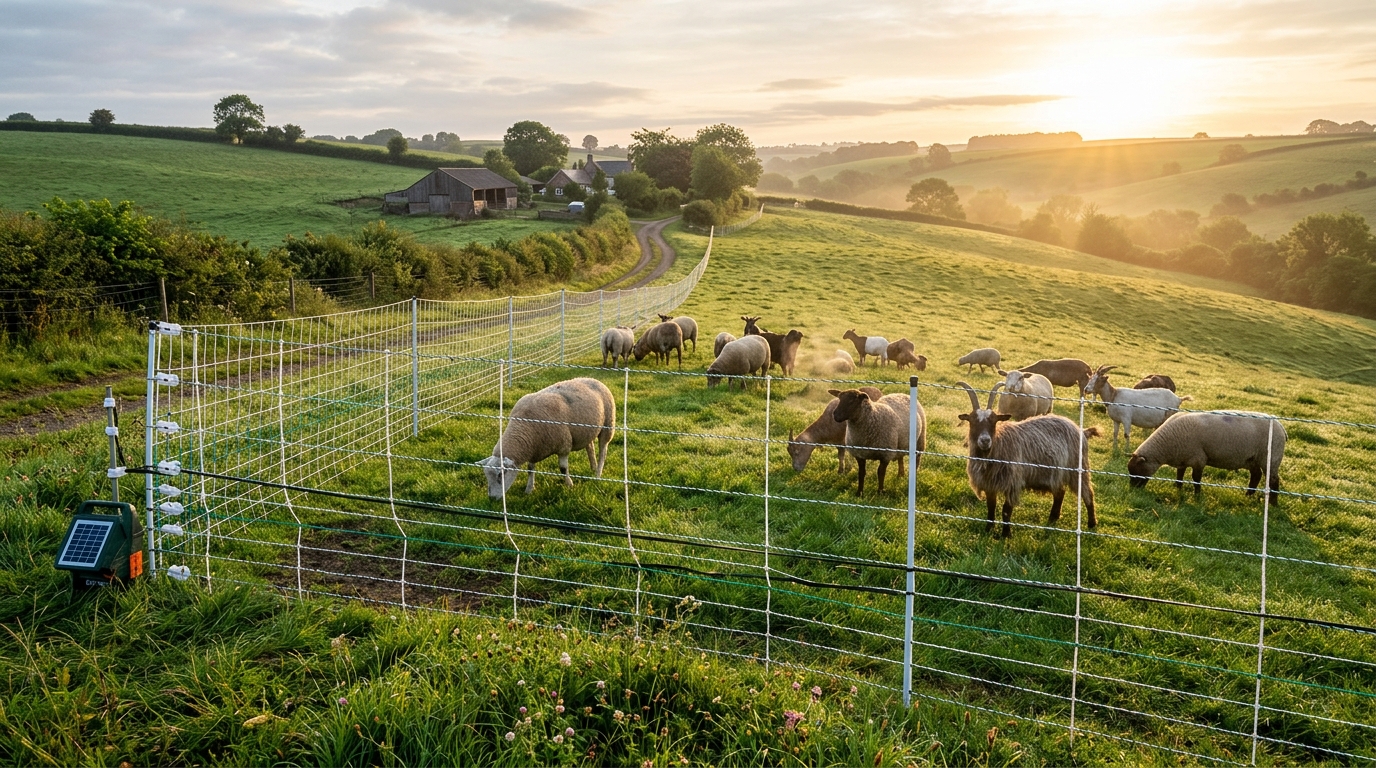
Anyone who tells you containing goats and sheep behind temporary wire is easy has never actually owned either. Goats are inquisitive, four-legged escape artists that treat physical fences like jungle gyms, rubbing their horns along post lines and testing every corner for an uncharged dead zone. Sheep, on the other hand, don’t climb—they simply don’t care. A mature ewe wrapped in two inches of dense, lanolin-rich fleece is basically wearing a heavy-duty rubber insulator. If your fence is running at a casual 2,500 volts, that sheep will lean against the wire, graze right beneath it, and push through without feeling a twitch.
To keep small ruminants where they belong, electric net fencing isn’t just a physical barrier; it is a psychological deterrent. The moment an animal touches that mesh with a wet nose, lip, or bare ear, it needs to receive an unforgettable 4,000 to 6,000-volt punch. At the same time, portable netting is the single most powerful tool in modern regenerative pasture management. It lets you run high-density rotational grazing, knock down invasive brush, trample organic matter into the soil, and break deadly parasite life cycles like Barber’s pole worm (Haemonchus contortus) by moving animals to clean forage every few days.
Beyond containment, portable netting serves as your first line of defense against nighttime predators. A hungry coyote, feral dog pack, or opportunistic black bear doesn’t knock before coming in. A tight, hot electric net stops them dead in their tracks before they can turn your lambing pasture into a slaughterhouse.
We spent months deploying, pulling, tensioning, and testing portable electric net rolls across rocky hillside pastures, overgrown brush paddocks, and heavy summer clover. Below are our top five field-tested picks for 2026, ranked by real-world durability, weed tolerance, ease of movement, and animal-holding reliability.
Our Top 3 Quick Picks
The undisputed gold standard for small ruminant management. With 42 inches of clearance to deter agile jumpers, 10 horizontal strands with ultra-conductive mixed-metal wiring, and rigid 12-inch vertical struts that refuse to sag, the ElectroStop delivers exceptional voltage retention and easy one-man field movement.
A rugged, wallet-friendly workhorse built for rotational pasture shifts. Features heavy-duty 6-inch galvanized double spikes, welded mesh joints, and high-contrast polywire that keeps both stubborn hair sheep and brush goats safely hemmed in without draining your equipment budget.
Engineered for high-predator zones and flighty goat breeds. Standing a full 4 feet tall with tight 6-inch vertical strut spacing and beefier composite line posts, PermaNet stays upright in brutal wind, rolls over rolling hills without billowing, and turns away coyotes, cougars, and rogue dogs.
Portable Electric Net Fencing Comparison Table
| Product | Height | Spacing & Spike | Joules Req. | Best For | |
|---|---|---|---|---|---|
| Premier 1 ElectroStop 42” | 42 in | 12” stays | 12.5’ post spacing | Double Spike | 0.25–0.5 J / roll | Best overall sheep & goat containment | Check Price |
| Starkline Sheep & Goat 40” | 40 in | 12” stays | 12.5’ post spacing | 6” Double Spike | 0.25 J / roll | Best value rotational grazing | Check Price |
| Premier 1 PermaNet 48” | 48 in | 6” stays | 12.5’ post spacing | Heavy Double Spike | 0.5–0.75 J / roll | Heavy predator defense & jumping goats | Check Price |
| Gallagher Sheep & Goat 42” | 42 in | 12” stays | 14 posts / roll | Double Pin Foot | 0.25–0.5 J / roll | Rough terrain & tough field conditions | Check Price |
| Premier 1 ElectroNet 35” | 35 in | 12” stays | 6.8’ or 12.5’ posts | Double Spike | 0.20–0.35 J / roll | Docile sheep & low-profile paddock splits | Check Price |
1. Premier 1 Supplies ElectroStop 42” Double Spike — Best Overall
If you ask seasoned graziers across North America what netting rides in the back of their side-by-side every single week, nine out of ten will point to the Premier 1 ElectroStop 42”. There is a simple reason for that dominance: it is purpose-built to address the exact failure points of small ruminant grazing.
Standing 42 inches installed, the ElectroStop gives you the critical 7 extra inches of vertical insurance that standard 35-inch sheep netting lacks. While calm sheep won’t challenge a 35-inch barrier, goats and alarmed lambs will clear lower fences without breaking stride. The 42-inch height creates a visual and psychological wall that keeps athletic Boer, Nubian, and Kiko goats grounded.
The mesh configuration features 10 horizontal strands, 9 of which are hot. Premier 1 uses a blend of stainless steel and tinned copper filaments in their horizontal conductors, resulting in an exceptionally low electrical resistance rating of approximately 38 ohms per 1,000 feet. That low resistance means current moves freely with minimal voltage drop over multiple linked rolls, even when pasture grass makes incidental contact with the lower live wires.
Where the ElectroStop truly outshines cheaper alternatives is its rigid molded plastic vertical struts spaced every 12 inches. Cheaper nets use flexible poly string verticals that sag the moment tension relaxes, causing the live bottom strands to drape into wet weeds and short out your energizer. The ElectroStop stays vertical and taut across swales and knolls. The built-in double-spike step-in posts feature heavy 6-inch galvanized steel spikes with an integrated foot pedal, allowing you to drive posts into hard clay without bending the fiberglass shafts.
Key Specs: 42” installed height | 164 ft roll length | 10 horizontal strands (9 live) | 12” vertical strut spacing | Built-in double-spike step-in posts | ~38 ohms/1,000 ft resistance | Black and white high-visibility twines
Pros
- 42” height reliably contains goats, jumpy hair sheep, and livestock guardian dogs
- Tinned copper/stainless mixed conductors deliver low resistance and hotter pulse
- Rigid 12” vertical struts prevent line droop and reduce weed contact shorts
- Sturdy double-spike footstep pedals sink easily in firm or uneven pasture soil
- Tough UV-stabilized poly construction resists sun degradation across multiple seasons
Cons
- Premium price point compared to entry-level generic rolls
- Requires extra guy-lines or corner bracing in heavy wind corners
- Can be bulky to fold single-handedly until you master the accordion technique
Ranch Approved Verdict: The absolute benchmark for portable rotational grazing. It hits the perfect balance between height, animal containment, conductivity, and manageable roll weight for routine pasture shifts.
2. Starkline Electric Sheep & Goat Netting 40” Double Spike — Best Value
For homesteaders, growing flocks, and commercial producers scaling up paddock acreage on a realistic budget, Starkline’s 40-inch Sheep & Goat Netting is hands down the best dollar-for-dollar investment available. It cuts the purchase cost by 20 to 30 percent compared to premium heritage brands while maintaining the core structural specifications needed to hold livestock.
At 40 inches high, Starkline split the difference between low-profile 35-inch sheep net and tall 48-inch predator mesh. In our pasture trials, 40 inches proved plenty sufficient for sheep and moderately trained goat herds. The net arrives fully pre-assembled in standard 164-foot (50-meter) rolls with 14 integrated fiberglass posts already laced into the mesh.
Each line post comes equipped with a heavy-duty 6-inch galvanized double-spike anchor. We were particularly impressed with the weld quality on the footstep bracket: even when driving posts into baked summer caliche with a heavy boot heel, the welds held true without flexing or snapping loose. The high-contrast white and cyan polywire pattern stands out brilliantly against brown autumn forage, green spring rye, and winter snow, helping your livestock spot the perimeter boundary from 50 yards away.
Conductivity is solid, utilizing braided stainless steel filaments. While stainless steel has higher internal resistance than copper-blend wire (meaning you’ll want a slightly stronger energizer if linking three or more rolls end-to-end), Starkline’s welded joints at the strand intersections prevent fraying and preserve circuit integrity. The non-electrified bottom strand keeps dirt contact from sapping your battery.
Key Specs: 40” installed height | 164 ft roll length | 9 horizontal strands (8 live) | 14 integrated fiberglass line posts | 6” galvanized double-spike base | High-visibility cyan/white polywire | Includes repair clips and tie-down stakes
Pros
- Outstanding value per linear foot of operational fencing
- Rugged 6” double spikes provide robust lateral stability in loose or sandy loam
- High-contrast cyan and white color scheme provides superior animal visibility
- Reinforced plastic welds at grid intersections prevent strand slip
- Includes practical repair accessories and tie-down ground stakes in the box
Cons
- Pure stainless steel conductors exhibit higher resistance over multi-roll runs
- Fiberglass posts have slightly more flex under heavy corner line tension
- Soft vertical stays require careful tensioning to prevent middle-span belly
Ranch Approved Verdict: The smartest value on the market for multi-paddock rotational systems. If you need to buy four or five rolls at once without draining the farm checking account, Starkline delivers dependable containment at a sensible price.
3. Premier 1 Supplies PermaNet 48” Double Spike — Best Heavy-Duty Predator Defense
When you are grazing sheep and goats in coyote country, adjacent to timberlines where feral dogs roam, or managing flighty horned breeds that look at normal fencing as a personal challenge, ordinary netting won’t cut it. You need a fortress on a roll. That is exactly what Premier 1 built with the PermaNet 48”.
Everything about the PermaNet 48” is heavy-duty. First is the height: a true 48-inch installed barrier. That 4-foot height stops jumping predators like coyotes and neighborhood dogs cold, while preventing athletic dairy goats from attempting to leap. Second—and most importantly—is the vertical strut spacing. While standard netting places vertical stays 12 inches apart, the PermaNet 10/48/6 features rigid vertical struts every 6 inches.
Cutting the vertical spacing in half completely transforms how the fence behaves in the field. It virtually eliminates fence sag between posts, prevents wind whipping from tossing the bottom hot wires into the turf, and maintains an uncompromising grid that small goat kids and lambs cannot force their heads through. Furthermore, the PermaNet upgrades the line posts to thicker composite fiberglass uprights with oversized double-spike steel footings that anchor deep into uneven terrain.
Because the PermaNet has twice as many vertical stays and heavier posts, it is noticeably heavier to carry (roughly 22 to 24 pounds per roll compared to 16 pounds for standard nets). It also creates more wind resistance, meaning you must set your corners firm. But if your goal is semi-permanent pasture enclosures that can stay put for weeks or months through high winds and aggressive predator stalking, nothing touches it.
Key Specs: 48” installed height | 164 ft roll length | 10 horizontal strands (9 live) | Tight 6” vertical strut spacing | Thicker composite fiberglass posts | Heavy double-spike base | Mixed metal low-resistance conductors
Pros
- True 4-foot height provides unmatched protection against jumping predators and goats
- 6” vertical strut spacing completely eliminates mid-span sag and wind whip
- Upgraded post diameter provides outstanding structural rigidity in rough terrain
- Tight grid spacing prevents livestock horns or heads from penetrating mesh
- Ideal for semi-permanent seasonal installations that remain in place for weeks
Cons
- Heavier roll weight makes daily moves more labor-intensive
- Higher cost reflects the dense strut and post architecture
- Requires a powerful energizer (0.5+ joules per roll) due to sheer surface area
Ranch Approved Verdict: The ultimate defense system for high-predator territory and stubborn, athletic livestock. It turns temporary netting into a formidable, semi-permanent security perimeter.
4. Gallagher Sheep & Goat Electric Netting 42” Double Spike — Best for Tough Conditions
Gallagher is legendary in the livestock fencing industry for commercial-grade agricultural hardware, and their 42-inch Sheep & Goat Netting lives up to the reputation. Built specifically for rough, stony pastures, abrasive brush lines, and harsh weather exposure, this net is tailored for producers who are hard on their gear.
The net stands 42 inches tall and spans 164 feet (50 meters). Gallagher outfits this roll with 14 heavy-duty integrated posts featuring a galvanized double-pin (double-spike) foot. The double pins are engineered with a slightly narrower taper that penetrates hard-packed pasture trails and clay soils far cleaner than blunt-welded stakes, reducing the effort needed to step posts flush into dry summer ground.
Gallagher places special emphasis on conductor longevity. The horizontal polywires feature heavy-gauge stainless steel filaments interlaced with high-density UV-stabilized monofilaments. The conductive clips at each end of the roll are stamped from solid marine-grade stainless steel with positive-locking brass wing nuts, guaranteeing a corrosion-proof, low-loss electrical union when chaining multiple rolls together across hundreds of yards of pasture.
Like all quality sheep and goat netting, the bottom strand is non-conductive to prevent grounding against the turf. Gallagher reinforces this bottom baseline with double-gauge black poly twine to resist rock abrasion, snagging on thorn scrub, and hoof trampling. The vertical struts are spaced at 12 inches and retain their spring temper even after being rolled, dragged through brush, and repeatedly unrolled across multi-acre rotations.
Key Specs: 42” installed height | 164 ft roll length | 9 horizontal strands (8 live) | 14 reinforced line posts with double-pin feet | Solid stainless connecting hardware | Heavy-gauge UV-stabilized poly twines | High-visibility orange and black coloring
Pros
- Tapered double-pin stakes penetrate baked, rocky, or hardpan soil with ease
- Commercial-grade end-clip hardware ensures zero-loss connections between rolls
- Reinforced abrasion-resistant bottom non-conductive strand resists field wear
- Excellent UV stability withstands scorching sun exposure without becoming brittle
- Bright orange poly strands offer instant visual recognition across timber edges
Cons
- Orange polywire can show dirt staining more readily than black/white mesh
- Slightly stiffer unrolling feel out of the box until broken in
- Standard 12” strut spacing can sag if corner posts are not pulled drum-tight
Ranch Approved Verdict: Commercial-grade toughness from the biggest name in electric fencing. If your grazing route crosses rocky ground, thorn thickets, and harsh elements, Gallagher’s double-pin net will outlast the competition.
5. Premier 1 Supplies ElectroNet 35” Double Spike — Best Low-Profile Pick for Docile Sheep
Not every flock requires a towering 4-foot wall. If you run docile, well-trained sheep breeds like Katahdins, Dorpers, St. Croix, or traditional wool breeds that respect an electric charge, the Premier 1 ElectroNet 35” is a fast, lightweight, and incredibly nimble tool for daily pasture management.
At 35 inches tall, this is the classic, original electric net design that kicked off the rotational grazing revolution decades ago. The lower profile provides three immediate practical advantages: it is roughly 25 percent lighter per roll than 42-inch and 48-inch nets, it experiences noticeably less wind drag in wide-open prairie pastures, and it is dramatically faster for one person to pick up, bundle, and move across paddocks without catching on shoulders or dragging in deep weeds.
The ElectroNet 35” features 9 horizontal strands (8 conductive) with 12-inch vertical strut spacing. Because there is less total mesh surface area, capacitive coupling with the ground is reduced. This means a smaller energizer can push high voltage across more rolls of ElectroNet 35” than it could across 48-inch predator netting. Even in late summer with moderate weed contact, a modest 0.5-joule solar charger can easily maintain 5,000+ volts across a multi-roll paddock.
However, honesty in the field is paramount: we do not recommend the 35-inch height for untrained goats, horned bucks, or pastures under active coyote threat. Athletic goats can casually jump a 35-inch fence if spooked or enticed by fresh brush on the opposite side. But for disciplined sheep grazing clean forage, internal pasture divisions, or strip-grazing cover crops, it remains an indispensable, lightning-fast setup.
Key Specs: 35” installed height | Available in 164 ft and 100 ft lengths | 9 horizontal strands (8 live) | 12” vertical strut spacing | Double-spike step-in posts | Low electrical resistance (~38 ohms/1,000 ft) | Lightweight, rapid-deployment design
Pros
- Lightweight and compact—the easiest roll to carry and move single-handedly
- Lower wind profile stays stable in blustery, open prairie pastures
- Requires less energizer joule output to maintain high operational voltage
- Proven mixed-metal conductors deliver a sharp, authoritative shock
- Perfect for fast internal paddock splits and intensive strip grazing
Cons
- 35” height is inadequate for containing flighty goats or stopping jumping coyotes
- Horns can tangle if animals challenge an underpowered line
- Lower top strand allows determined predators to leap over in desperation
Ranch Approved Verdict: The undisputed champion for fast, low-effort sheep rotations. If your animals are already trained to electric fencing and you don’t face jumping predators, this lightweight roll will save your back every grazing season.
Practical Ranch Buying Guide: Mastering Mobile Netting in the Field
Buying the right roll of netting is only half the battle. Operating electric net fencing out in the dirt requires an understanding of pasture physics, animal behavior, and electrical grounding. Here is what every rancher needs to know to keep their fences hot, straight, and trouble-free.
1. Why Electric Netting Demands 0.25+ Joules Per Roll
One of the most common mistakes new graziers make is pairing portable netting with a small garden fence charger rated for 0.05 to 0.10 joules. They plug it in, test it in the driveway, see 6,000 volts, and assume everything is fine. Two days later, their goats are grazing in the neighbor’s garden.
Unlike a single strand of smooth high-tensile wire hanging on plastic insulators 3 feet off the ground, electric netting consists of 8 to 10 parallel conductors suspended just inches above the earth. This geometry creates a massive electrical phenomenon known as capacitive coupling. The parallel wires act like a giant electrical capacitor with the soil beneath them. Every pulse of high voltage pushes current into this field, causing natural electrical leakage even if not a single blade of grass touches the wire.
As soon as real pasture conditions hit—morning dew, bent clover heads, dandelion stems, and rain splashes—that leakage multiplies into thousands of tiny resistance paths to ground. A weak garden charger lacks the stored electrical energy (joules) to push past this resistive bleed. Its output immediately collapses from 6,000 volts down to a useless 1,200 volts.
To keep sheep and goats contained, you need an energizer that delivers a minimum of 0.25 output joules per 164-foot roll in clean pasture conditions, and 0.50 to 0.75 joules per roll if grazing through moderate weeds or brush. If you are linking four rolls together to enclose an acre (656 linear feet), you need an energizer with at least 1.5 to 2.0 real output joules to burn through pasture load and maintain an authoritative 5,000-volt punch.
Before setting up your portable paddocks, consult our comprehensive field review of the best electric fence chargers in 2026, where we break down heavy-hitting AC, battery, and solar energizers—like the Parmak Magnum Solar-Pak 12 and Patriot P30—that have the muscle to keep mobile net paddocks blistering hot.
2. Overcoming High Weed Load and Ground Shorts
Every quality electric net manufactured today features an un-electrified (neutral) bottom strand. That bottom line is woven from straight plastic monofilament with zero metal conductors. It is designed to rest directly against the ground without causing a dead short.
However, the second horizontal strand is positioned just 3 to 4 inches above the turf—and that strand is live. When pasture grasses grow, or when you drag the net across uneven terrain, that second wire will inevitably contact vegetation. Green grass contains water and minerals, making it a viable conductor that bleeds voltage directly back to the earth.
Here is the four-step protocol experienced graziers use to prevent vegetation shorts:
- Mow Fence Lanes 24 Hours Ahead: Run a brush hog, riding mower, or zero-turn mower along your planned paddock perimeter the day before moving livestock. Scalping a 24-inch path gives the netting a clean, weed-free runway. Giving the cut grass 24 hours to wilt in the sun ensures any clippings touching the wire dry out and lose conductivity.
- Level Out Dips and Swales: If the fence crosses a depression, do not let the live second wire sag into the hump. Use an extra plastic step-in post or guy-line stake to elevate the line over high spots and pin the bottom strand down in low swales.
- Monitor Regrowth on Extended Stays: In rapid spring flushes, grass can grow 2 inches in 48 hours. If animals are staying in one paddock for more than 4 days, walk the line with a weed trimmer or hook up a higher-joule energizer capable of drying out green grass tips.
- Never Graze Muddy Wallers Without Elevation: In wet spring weather, sheep and goats will create muddy paths along the fenceline. Mud splashed onto live strands creates an instant carbonized short. Keep post tension tight so the mesh remains suspended.
3. Grounding Mobile Fences: Solving the System’s Weakest Link
Nine out of ten electric fence “failures” reported on small farms have nothing to do with broken wires or defective energizers. They are caused by an inadequate ground system.
An electric fence is an open circuit. When an animal touches a live strand, current flows through its body, enters the soil through its hooves, travels through the earth back to the energizer’s ground rod, and enters the terminal to complete the shock. If the ground rod cannot pull that current out of the dirt, the animal feels nothing.
In portable rotational systems, driving a permanent 8-foot copper rod every three days is impractical. But relying on a 12-inch rebar stake in bone-dry summer dirt will leave your fence completely dead. Follow these field-proven grounding rules:
- Use 3-Foot Galvanized Ground Rods Minimum: Carry a dedicated 3 to 4-foot galvanized T-handle ground rod or 1/2-inch copper rod. The galvanized zinc coating prevents rust from acting as an insulator between the rod and the soil.
- Drive Rods in Low, Damp Ground: Always place your energizer and ground stake in the lowest, dampest soil available near the paddock—a swale, pond edge, or shaded tree drip line. Moist soil conducts electricity hundreds of times better than baked clay.
- Multi-Rod Systems for Dry Sand and Gravel: If grazing on sandy soil or dry rocky ridges, drive two or three 3-foot ground stakes spaced 6 feet apart and connect them in series with insulated cable and heavy-duty brass ground clamps. A solid pair of fencing pliers (check our roundup of the best fencing pliers in 2026) is essential here for securing clamps and levering stubborn stakes out of hard ground.
- Positive/Negative (Return-Wire) Netting for Arid Regions: In desert pastures or during severe droughts where the soil contains zero moisture, standard earth-return fences fail. In these conditions, use a Positive/Negative (Pos/Neg) net setup. On Pos/Neg nets, alternating horizontal strands are connected to the positive terminal and negative (ground) terminal of the energizer. When a goat touches both strands simultaneously, current passes directly between the wires through the animal, delivering a maximum shock regardless of bone-dry soil.
- Diagnosing Voltage Leaks with a Fault Finder: When your voltage drops from 6,000V to 2,500V, searching hundreds of feet of mesh by eye is maddening. Invest in a dedicated directional digital fault finder. See our guide to the best electric fence testers in 2026 to learn how directional amp meters instantly point you straight toward the weed patch, cracked insulator, or corroded jumper draining your power.
4. Single Spike vs. Double Spike Posts: Why the Choice Matters
When ordering electric net rolls, you will face an immediate choice between Single Spike and Double Spike line posts. Unless you are grazing in a very specific environment, double spike is hands-down the superior option for working ranchers.
| Feature | Double Spike Posts | Single Spike Posts |
|---|---|---|
| Ground Anchoring | Two steel prongs resist twisting in high wind and rocky ground | Single prong pivots and loosens under lateral line pull |
| Step-In Mechanism | Integrated cross-piece foot pedal allows full bodyweight drive | Small molded plastic step often flexes or breaks under heavy boots |
| Corner Tensioning | Anchors firmly against diagonal tension; less corner post flex | Pivots in soft soil; requires extensive guy-lines and corner stakes |
| Soil Suitability | Outstanding in loamy, soft, wet, sandy, or standard pasture soils | Excels only in heavily frozen ground or extremely dense, rocky hardpan |
| Handling & Pulling | Requires a deliberate vertical boot-pull to unseat two prongs | Faster and lighter to pull out of the ground during teardown |
Double spike posts feature a heavy-gauge steel step bracket welded between two 6-inch galvanized spikes. When you push your boot heel down on the step plate, your bodyweight drives both spikes parallel into the soil. This prevents the post from spinning in circles when the wind blows and stops the top of the fence from leaning inward when tensioned around turns.
The only scenario where single-spike posts hold an advantage is in late winter when the ground is frozen rock-hard, or in hyper-dense gravel where finding two clear entry paths through the stones is impossible. For 95 percent of pasture rotations, double-spike posts are worth every extra penny in stability and sanity.
5. The Field Accordion Technique: How to Move Netting Without Tangles
The biggest frustration graziers encounter with electric netting is turning a 164-foot roll into a bird’s nest of knotted polywire. If you drag an open net across the ground or roll it up like a carpet, the vertical plastic struts will catch on the horizontal wires, creating a half-hour knot-untangling nightmare.
To pack and move netting flawlessly, use the accordion fold:
- Kill the Power: Turn off the energizer and disconnect the lead-out cables. Test with your voltmeter to ensure the line is dead.
- Gather Posts Together: Walk down the fenceline, pulling each post straight out of the ground by stepping on the spike bracket or gripping the fiberglass near the base. Keep all the posts bundled together in one hand, letting the mesh fold back and forth between them like the bellows of an accordion.
- Keep Spikes Pointed Down: Never tilt the posts horizontally while gathering. Keep the steel spikes pointing down toward the ground and the tops aligned.
- Tie the Bundle: Once all 14 posts are collected in your grip, lay the bundled posts on the ground. Take the loose mesh tail, wrap it tightly around the bundle of posts, and secure it with the included tie string or a quick-release bungee.
- Reverse to Deploy: To set the fence back up, lay the post bundle down, take the first anchor post, step it into the soil, and simply walk down the new fenceline pulling one post out of the bundle at a time. The net will unfold smoothly behind you without a single knot.
Final Verdict: Which Electric Net Fencing Is Right for You?
Choosing the best portable electric net fencing comes down to your livestock species, predator pressure, and rotation frequency:
- For 90% of Sheep & Goat Operations: The Premier 1 ElectroStop 42” Double Spike is our top recommendation. Its 42-inch height deters escape artists, while low-resistance mixed-metal conductors and rigid vertical struts ensure your animals receive a sharp, unforgettable lesson the first time they test the perimeter.
- For Cost-Conscious Expansion: Choose the Starkline Sheep & Goat 40” Double Spike. It offers durable galvanized hardware, welded joints, and dependable containment at a price that lets you buy multiple rolls to expand your grazing acreage.
- For Coyote Country & Jumping Goats: Step up to the Premier 1 PermaNet 48” Double Spike. With 4-foot height and tight 6-inch vertical stays, it creates an impenetrable barrier that keeps agile stock in and aggressive predators out.
- For Rocky, Abrasive Terrain: The Gallagher Sheep & Goat 42” Double Spike features tapered double pins, reinforced non-conductive rub strands, and commercial-grade stainless connection hardware built to take a beating.
- For Gentle Sheep & Quick Internal Splits: The Premier 1 ElectroNet 35” Double Spike is the fastest, lightest roll to carry and move across internal paddocks where height is not an issue.
No matter which net you choose, remember that the mesh is only as effective as the current running through it. Pair your netting with an energizer pushing at least 0.25 to 0.50 joules per roll, keep your fence lanes mowed, maintain a deep, moist ground rod, and check your voltage daily. Do that, and your portable electric netting will transform your pasture productivity, protect your herd, and make rotational grazing one of the most rewarding chores on your ranch.