Ranch Approved is reader-supported. When you buy through links on our site, we may earn an affiliate commission at no extra cost to you. How we research.
There is no sick feeling quite like walking out to your morning pasture shift and finding a prize breeding buck or registered ewe tangled dead in a roll of electric netting. The animal panicked, twisted itself into a straightjacket of polywire, and suffered either strangulation, heat exhaustion, or continuous shock pulses until its heart gave out. It is a heartbreaking sight, and it is the exact reason dozens of homesteaders and small-scale graziers roll up their netting after a single season and swear they will never touch the stuff again.
Here is the hard, unvarnished truth from seasoned livestock producers: electric fence entanglement is 100 percent preventable. Portable electric netting is not a physical barrier like six-foot chain-link or welded livestock panels. It is a psychological wall. If you toss an untrained flock or herd of goats into an open pasture with an electric net, you are essentially surrounding them with a nylon gill net and hoping for the best.
Sheep and goats do not instinctively understand electricity. They must be systematically taught to respect the boundary in a controlled, low-stress environment where panic cannot turn fatal. Once trained, your stock will treat the thinnest strand of white polywire like a ten-foot concrete wall, leaving a respectful three-foot grazing buffer around the perimeter.
Whether you just bought your first roll of netting from our best portable electric net fencing guide or you are introducing a batch of green yearling ewes to your rotational grazing rotation, this step-by-step field protocol will train your livestock safely, reliably, and without a single lost animal.
Essential Gear for Netting Training
Never guess whether your training line is hot enough. The SmartFix displays exact peak line voltage in kilovolts and amperage direction, verifying that your training paddock delivers at least 4,500V before a single animal sets foot inside.
Pumping out 3.0 stored joules, the Patriot P30 delivers the authoritative punch needed to shock through thick wool fleece and coarse goat hair. Runs on 110V AC at the barn or 12V battery in the field.
Rigid 12-inch vertical plastic struts keep the mesh taut and vertical, preventing mid-span belly and sagging corners that invite curious horns. The 42-inch height prevents agile goats from jumping the training barrier.
The Mechanics & Animal Psychology of Entanglement
To train livestock effectively, you have to understand how their nervous system and body geometry react to an electric pulse. An animal’s physical response to an electric shock depends entirely on where that shock lands on its body.
The Nose Shock vs. The Neck Shock
When an inquisitive sheep or goat investigates something new in its territory, it leads with its head. Its moist, uninsulated nose, lips, and muzzle are packed with sensitive sensory nerve endings. When an energized polywire contacts that wet muzzle, the shock is sharp, instantaneous, and intense.
The natural, involuntary neurological reflex of a mammal shocked on the front of its face is to flinch and jump backward. The animal recoils violently, snorts, backs into the center of the pasture, and burns an indelible lesson into its memory: “That mesh bites hard when I touch it with my face.”
Now consider what happens when training is skipped. An animal wanders toward the fence while grazing with its head down, or rubs along the line while chewing cud. The first contact does not hit its sensitive nose—it touches the coarse guard hair of its shoulder, the back of its neck, or an insulated ear. Coarse hair and dense wool dampen the electrical pulse. The animal feels a mild, annoying tickle rather than an authoritative shock.
When an ungulate feels a threat or stinging sensation on its neck or flank, its survival instinct is not to back up—it is to bolt forward to outrun the predator. Bolting forward drives the animal’s head, horns, and shoulders straight into the 6x6-inch mesh squares of the fence. By the time the higher-voltage wires make direct skin contact, the animal is already through the grid. Thrashing ensues, and entanglement becomes critical within seconds.
Horn Geometry: The One-Way Barbed Hook
If you raise goats (such as Boers, Kikos, Spanish, or dairy breeds) or horned sheep (such as Jacobs, Navajo-Churros, or Wiltshire Horns), you are dealing with built-in fishhooks. Horns naturally sweep backward away from the forehead.
When a goat pushes its head through a square of electric netting, the smooth, tapered horns glide easily forward through the flexible mesh opening. But when the animal feels the shock and tries to pull backward, the horn tips catch on the horizontal and vertical polywire strands like barbs. As the animal jerks its head back and forth, the strands wrap tighter around the horn base, pinning the goat’s head directly against the live conductors.
The Two Fatal Flaws That Cause Disasters
Every entanglement incident we have investigated on working ranches boils down to one of two structural failures:
- Slack, Sagging Netting: If your corner posts are not guy-lined, or if line posts are spaced too far apart over uneven ground, the netting bellies outward. A sagging top strand sits at chest height, practically inviting animals to lean over or step into it.
- Weak, Underpowered Energizers: A fence charger operating at 2,000 to 2,500 volts is useless for training. Lanolin-rich wool and goat hair have high electrical resistance. A weak pulse won’t arc through the coat, meaning the animal won’t feel anything until it is already mechanically trapped.
The Golden Rule: Minimum 4,000V to 5,000V Before Entry
Before you let a single sheep or goat near a roll of netting, your energizer must be putting out serious voltage. For training purposes, the absolute minimum threshold is 4,000 volts under load, with 5,000 to 6,000 volts being the ideal target.
You cannot estimate voltage by listening to the charger tick or tapping the wire with a blade of grass. You must verify the fence line with a dedicated digital fence tester. Review our comprehensive guide to the best electric fence testers in 2026 to find a reliable digital voltmeter or directional fault finder.
An underpowered electric net is worse than no fence at all; it is a lethal trap. If your charger cannot maintain 4,500 volts across a clean training paddock, you either have an undersized energizer or an inadequate ground system. Upgrade to a proven unit from our roundup of the best electric fence chargers in 2026 before proceeding.
Step-by-Step Training Pen Protocol
| Training Method | Setup Requirement | Entanglement Risk | Containment Safety | Herd Success Rate | Verdict |
|---|---|---|---|---|---|
| Hard-Corral Inner Paddock | Net inside secure barnyard / pipe panel corral | Near Zero (monitored) | 100% (backed by hard perimeter) | 99%+ | Recommended Gold Standard |
| Bait-Only Open Pasture | Net in open field with grain pans or foil | High (spooked stock bolt into brush) | Poor (risk of pasture escape) | 65–75% | High Risk — Not Recommended |
| Un-Energized Habituation | Letting animals “get used to” dead wire | Catastrophic (acts as a gill net) | Zero | 0% (frequent fatalities) | Prohibited — Fatal Flaw |
Follow this five-step sequence to train your herd safely and permanently.
Step 1: The “Pen-Within-a-Pen” Setup
Never train livestock to electric netting out in the middle of a 10-acre open pasture. If a sheep gets zapped and panics, it might break through the net and sprint into the woods or onto a county road before you can catch it.
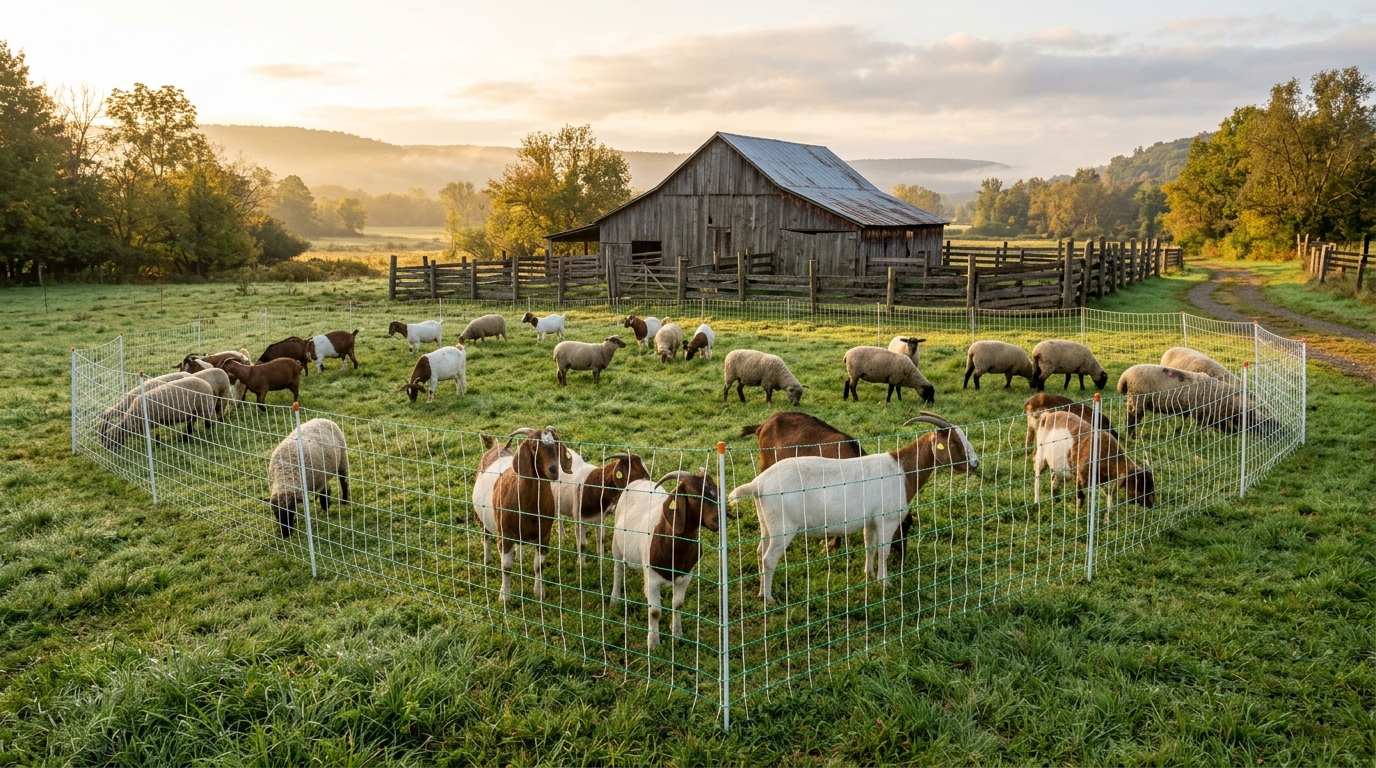
Set up your training pen inside an existing, secure, hard-fenced enclosure. A barnyard pen, dry lot, or corral made of welded wire cattle panels, wooden boards, or heavy pipe fencing is ideal. Erect your roll of electric netting inside this perimeter, leaving a 4 to 6-foot buffer zone between the netting and the hard corral walls. If an animal breaks through the net in a blind panic, it is still securely contained by the outer fence.
Step 2: Taut Tensioning & Corner Guy Lines
Set up the electric net as tight as a drum. Drive the corner posts completely plumb into the soil. Run heavy poly guy-lines from the tops of each corner post to steel tent stakes driven four feet out, pulling back against line tension. Every line post must be stepped in deep, and the net must stand completely vertical with zero middle sag.
Clear all tall weeds, thistle stalks, and grass clippings beneath the net. Even though the bottom strand is non-conductive, the second strand (located 3 to 4 inches off the dirt) is hot. Any green vegetation touching that second wire will bleed off precious voltage.
Step 3: Energizing and Testing the System
Drive a dedicated 3 to 4-foot galvanized ground rod into damp soil adjacent to your corral. Connect your energizer’s ground lead securely to the rod using a brass clamp, and hook the positive fence lead to the net’s top conductor clip.
Power up the charger and test the voltage at three points: directly at the lead-in clip, at the middle post, and at the farthest corner. You must see at least 4,500 volts on your digital tester. If the reading is lower, check for grass shorts along the bottom wire or soak the soil around your ground rod with five gallons of water.
Step 4: The Curiosity & Nose-Touch Phase
Bring the animals into the training corral calmly during broad daylight. Never train animals at dusk, at night, or during feeding frenzies when they are rushing for hay. They need clear visual conditions and calm minds to connect the shock to the fence.
To guarantee that the first shock contacts the animal’s moist nose rather than its neck, use conductive visual attractors:
- Tear off three-inch strips of standard aluminum foil.
- Wrap the foil strips around the third or fourth horizontal live wire (about nose height for your stock), spacing them every 10 to 15 feet along the fence.
- Smear a thin dab of peanut butter, molasses, or apple sauce onto the face of the foil.
Step back, stay quiet, and let natural curiosity take over. Goats and sheep are intensely inquisitive creatures. Within minutes, the herd leader or dominant buck will spot the shiny foil, smell the sweet treat, and walk over with an extended neck. The animal will sniff and extend its wet nose to touch the bait.
The resulting 5,000-volt pulse will hit the muzzle like a hammer. The animal will let out a loud snort, rear back, and jump four feet backward into the pen. The rest of the herd will watch this reaction intently. One by one, over the next two hours, the remaining animals will cautiously test the foil or the white polywire with their noses and receive the same unforgettable lesson.
Step 5: The 48-Hour Supervision Window
Keep your herd inside the training corral for a full 24 to 48 hours. Never leave them unattended during the first four hours of introduction. Grab a stool, keep your fencing pliers in your back pocket, and monitor their behavior from outside the pen.
By the end of the second day, you will notice a distinct psychological shift. The animals will graze calmly, but they will maintain an intentional 2 to 3-foot buffer from the netting. If an animal accidentally drifts close while grazing, a herd mate will bump it away or it will glance at the white mesh and immediately back off. Once the entire group respects the line without hesitation, they are fully trained and ready for open-field rotational grazing.
Special Management: Horned Goats, Kids, and Lambs
Certain classes of livestock require extra caution when introducing electric net systems.
Young Kids and Lambs (Under 3 Months)
Young lambs and goat kids have two strikes against them: they have small body mass (meaning they ground out poorly and feel less shock), and their heads are small enough to slip clean beneath the second horizontal strand. If a two-week-old kid sees its mother on the other side of a paddock line, it will dart under the bottom wire without hesitation.
The Rule: Never turn nursing kids or young lambs into electric netting pastures until they are at least 8 to 12 weeks old, fully mobile, and trained alongside their mothers in the hard corral. The mother’s cautious behavior around the fence is the most effective training tool a young animal can have.
Aggressive Horned Bucks and Wethers
Mature bucks have thick, calloused horn ridges that carry zero nerve sensation. During rutting season in late summer and autumn, bucks love to thrash brush, fence posts, and wire to vent testosterone and mark territory. If an untrained buck hooks his horns into an electric net, he won’t feel the charge on the horn bone itself, but as he twists, the wire will contact his ear or poll.
To manage horned bucks safely:
- Always use 42-inch or 48-inch netting (such as Premier 1 ElectroStop or PermaNet) with rigid vertical stays. Short 35-inch sheep netting is far too easy for horned goats to step over or tangle.
- Ensure your training voltage is running at 5,500V or higher. A high-joule pulse will arc across the small air gap between the wire and the buck’s horn base, delivering a memorable shock to his scalp before his horns can wedge deep into the grid.
- If an individual buck has a persistent habit of rubbing horns on the fence, install a 12-inch piece of 1/2-inch PVC pipe taped horizontally across his horns as a temporary horn spreader. The PVC pipe prevents his horn tips from entering the 6x6-inch mesh openings while he unlearns the habit.
Emergency Entanglement Response Protocol
Even with rigorous training, an unforeseen accident can happen—a stray dog chases your herd into the fence at night, or a falling tree branch downs a corner post. If you ever discover an animal tangled in an electric net, follow this emergency checklist immediately:
- Cut the Power Immediately: Run to the energizer and flip the power switch off, disconnect the lead-out clip, or shut off the circuit at the solar battery. Never attempt to untangle a thrashing animal from an active 5,000-volt fence with bare hands.
- Calm the Animal: Approach the animal calmly from behind. Throw a heavy canvas jacket, feed sack, or blanket over the animal’s head to cover its eyes. Deprived of vision, sheep and goats instinctively freeze and stop thrashing, preventing further strangulation.
- Cut the Netting with Fencing Pliers: Do not waste ten minutes trying to gently untie knots while an animal is choking. Pull your heavy fencing pliers and snip the horizontal and vertical polywire strands pinning the animal’s horns or neck. Polywire netting can be repaired in five minutes with copper crimps or flat Western Union splices; an animal’s life cannot be replaced.
- Assess for Shock Trauma and Heat Stroke: Once free, check the animal’s airway, eyes, and horn bases. Check body temperature. Animals that thrash while receiving continuous electric shocks can experience severe muscle breakdown (rhabdomyolysis) and hyperthermia. Move the animal to a cool, shaded barn stall, offer cool water with electrolytes, and monitor for shock. Contact your large-animal veterinarian if the animal cannot stand or shows signs of respiratory distress.
Final Field Verdict: Training Pays for Itself
Taking 48 hours to properly train your sheep and goats in a secure corral might feel like an annoying delay when green pastures are calling. But that simple two-day investment is the difference between enjoying decades of seamless, high-density rotational grazing or dealing with the nightmare of lost livestock.
Keep your voltage above 4,500V, maintain drum-tight corners, bait the fence with aluminum foil so the first contact is on the nose, and give the animals time to understand the psychological boundary. Do that, and your electric net fencing will become the safest, most effective, and most versatile pasture management tool on your ranch.