Ranch Approved is reader-supported. When you buy through links on our site, we may earn an affiliate commission at no extra cost to you. How we research.
Loose trace mineral is one of the highest per-pound investments you will make in your cattle herd’s nutritional health. At $35 to $65 for a 50-pound bag of breeder-grade loose mineral loaded with bioavailable chelated copper, zinc, phosphorus, selenium, and vitamin A, every single ounce counts. Yet every spring and fall across cattle country, thousands of dollars worth of premium mineral are lost to driving rain, whipping prairie winds, and aggressive 2,000-pound herd bulls that treat flimsy feeders like playground toys.
When an unprotected open trough takes on two inches of torrential rain, water dissolves the high-value water-soluble trace elements, washing phosphorus and salt straight through drain holes into the pasture mud. Worse yet, when wet mineral dries in the summer sun, it hardens into an impenetrable block of caked concrete that cattle cannot consume, leading to severe nutritional deficiencies, stalled average daily gain (ADG), and open cows during breeding season. If your feeder flips over when a bull scratches his poll against it, fifty pounds of expensive loose mineral is trampled into the dirt in seconds.
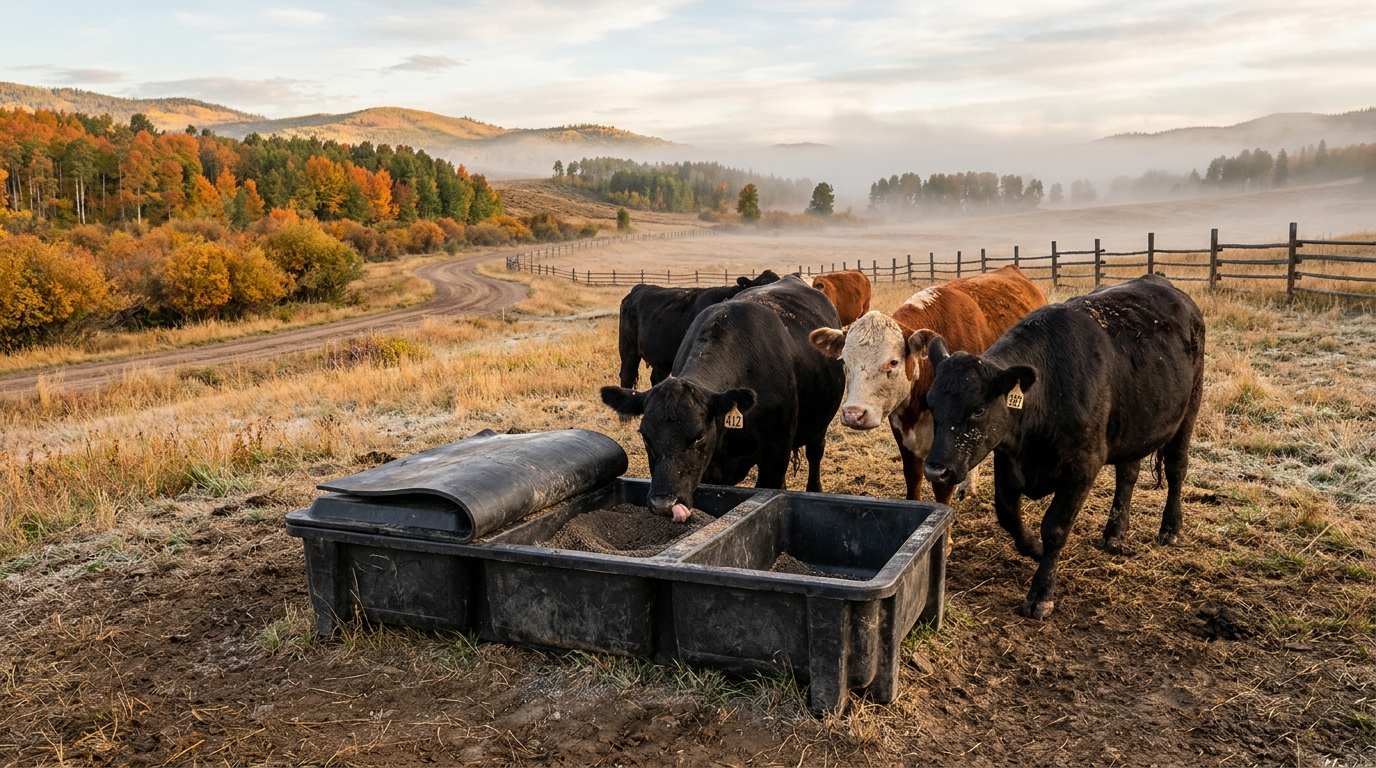
Investing in a heavy-duty, weatherproof mineral feeder protects your cash investment and ensures that cows, heifers, and herd bulls consistently consume their target two to four ounces per head daily. We evaluated ground tubs, rubber-flap enclosures, 360-degree wind-vane swivels, and fly-control feeders on working commercial ranches. Here are the six best cattle mineral feeders that stand up to brutal weather and rough cattle pressure in 2026.
Top 4 Quick Picks
The undisputed king of pasture durability. Features a massive 48-inch ultra-low center of gravity, heavy-duty rotational molded polyethylene that never rusts, three independent feed compartments, and a thick 3/8-inch vulcanized rubber flap that shields mineral from driving rain while bulls and cows lift it effortlessly.
Conquer summer pinkeye and horn flies automatically. Combines a weather-shielded mineral hopper with an overhead canvas mop saturated with liquid insecticide and mineral oil, treating the animal’s face, ears, and poll every time it sticks its head in to feed.
The ultimate solution for high-wind open plains. Its aerodynamically balanced wind-vane hood swivels 360 degrees on greaseable sealed bearings, turning its back to prevailing winds and driving rain so the feeding opening is always shielded on the leeward side.
Ideal for corrals, calving jugs, creep pens, and small paddocks. Mounts securely to wooden plank fences or round corral pipe panels, keeping mineral up off wet soil while thick UV-stabilized poly resists trampling and head-butting.
Cattle Mineral Feeders Comparison Table
| Model | Feeder Style | Capacity (lbs) | Weather / Rain Protection | Tip & Bull Resistance | |
|---|---|---|---|---|---|
| Behlen Country 3-Compartment | Ground Tub w/ Rubber Flap | 200 lbs (3 x 65 lbs) | Exceptional (3/8” Rubber Flap) | Unbeatable (Wide Low Base) | Check Price |
| Tarter Face-Fly Mop Feeder | Hooded Tub + Insecticide Wick | 150 lbs | High (Hood + Felt Curtains) | High (Tough Tubular Base) | Check Price |
| Sioux Steel 360° Wind-Vane | Weathervane Swivel Hood | 150 lbs | Exceptional (Rotates with Wind) | Exceptional (Heavy Steel Skids) | Check Price |
| High Country Plastics Wall Feeder | Fence / Pipe Panel Mount | 50 lbs | Moderate (Deep Overhang Hood) | High (Bolted to Rigid Fence) | Check Price |
| Tire-Mounted Tub & Flap Kit | DIY Heavy Equipment Tire | 200 – 300 lbs | High (Heavy Rubber Belting) | Indestructible (500+ lb OTR Tire) | Check Price |
| Little Giant 50 lb Block Holder | Wall / Post Salt Holder | 50 lb Block | Low (Open Top Grid) | High (Impact-Resistant Poly) | Check Price |
1. Behlen Country 3-Compartment Poly Ground Mineral Feeder — Best Overall Ground Feeder
If you want a feeder that you can drop in a rough 80-acre pasture, fill with three 50-pound bags of mineral, and walk away without worrying about tipped tubs, broken hinges, or soaked salt, the Behlen Country 3-Compartment Poly Feeder is the benchmark. It has survived millions of cow days across North America because it obeys the fundamental rule of pasture equipment: eliminate moving metal parts and make the base impossible to flip.
The tub is rotationally molded from high-density, UV-stabilized polyethylene that will never rust, crack in sub-zero winter temperatures, or degrade under harsh summer solar radiation. Measuring a massive 48 inches across the base with a low 15-inch profile, it creates an ultra-wide center of gravity. Even when a 2,200-pound herd bull rests his brisket on the rim or hooks it with his poll, the broad bottom flare prevents him from getting underneath to flip it over.
The secret to its weatherproofing is the heavy, 3/8-inch vulcanized rubber flap. Anchored firmly across a heavy molded center hub, the thick rubber disc drapes completely over all three feeding chambers. Cattle learn to use it within minutes: a cow simply approaches, nudges the rubber flap upward with her nose or forehead, licks her fill of loose mineral, and when she pulls her head out, gravity snaps the rubber disc back down tightly over the rim. It keeps driving horizontal rain, snow, and blowing debris out of your mineral, preserving leaf and trace mineral integrity all season long.
The interior is divided into three separate compartments. This lets you offer targeted free-choice loose trace mineral in one bay, coarse white mixing salt in the second, and a high-magnesium supplement or breeder booster in the third. It holds up to 200 pounds of mineral with ease, reducing your pasture refill trips.
Key Specs: 48” base diameter | 15” height | ~45 lbs empty weight | 200 lbs capacity | Heavy-duty 3/8” vulcanized rubber flap | 3 independent molded compartments | UV-stabilized rotationally molded poly
Pros
- Ultra-wide 48” low-profile base makes tipping virtually impossible for herd bulls
- Thick 3/8” vulcanized rubber flap seals tightly against horizontal rain and wind
- Three separate compartments allow simultaneous free-choice mineral, salt, and magnesium
- 100% rust-proof high-density polyethylene construction lasts decades in the field
- Simple, passive operation with zero metal hinges, springs, or linkages to rust
Cons
- Heavy to move across pastures by hand when fully loaded; best transported in a UTV bed
- Young spring calves under 200 lbs may take several days to learn to lift the heavy flap
Ranch Approved Verdict: The gold standard in cattle mineral feeders. Virtually indestructible, bull-proof, and 100% weatherproof. If you run commercial cows or bulls on open pasture, this is the feeder to buy.
2. Tarter Cattle Mineral Feeder with Face-Fly Insecticide Mop — Best Fly Control Feeder
Every summer across cow country, face flies (Musca autumnalis) wreak absolute havoc on herds. Unlike horn flies that feed on blood along the back and belly, face flies feed exclusively on ocular secretions, nasal mucus, and saliva around the eyes and muzzle. In doing so, their abrasive mouthparts scratch the cornea and transmit Moraxella bovis, the pathogenic bacteria responsible for infectious bovine keratoconjunctivitis—commonly known as pinkeye.
A severe pinkeye outbreak can blind calves, cause 10% to 20% drops in weaning weights, require intensive chute treatments (see our guide to the best cattle chutes and headgates for small farms), and destroy eye health. The Tarter Face-Fly Feeder attacks this problem at the exact point of daily herd aggregation: the mineral trough.
This feeder features a heavy-duty, weather-shielded poly mineral tub mounted securely within a rigid tubular steel frame. Positioned directly above the feeding entrance is a heavy-duty canvas mop and saturated felt wick reservoir. You fill the upper reservoir with a standard mixture of approved livestock permethrin insecticide and food-grade mineral oil. As each cow reaches into the hooded opening to access the mineral, her forehead, face, eyebrows, and ears rub firmly against the saturated canvas fringe.
This daily, self-administered application creates an impenetrable chemical barrier that repels face flies, horn flies, and lice without requiring you to run cattle through the working alley for pour-on treatments every three weeks. Pair this with a high-retention fly-repellent tag from our review of the best ear tags and tag applicators for unmatched summer fly control.
Key Specs: 150 lbs mineral capacity | Heavy tubular powder-coated steel frame | UV-resistant polyethylene tub | Integrated canvas mop and felt-wick insecticide dispenser | Hooded weather shroud | Broad tubular base for anti-tip stability
Pros
- Automates daily face-fly and pinkeye control with zero extra chute labor
- Coats face, poll, and ears with insecticide every time cattle feed on mineral
- Weather-shielded poly hood keeps driving rain from ruining loose mineral
- Sturdy tubular steel base prevents cattle from flipping the feeder over
- Dramatically reduces summer veterinary antibiotic costs for pinkeye doctoring
Cons
- Requires regular inspection and refilling of the insecticide/mineral oil reservoir
- Canvas mops need cleaning or replacement every two to three seasons of heavy use
Ranch Approved Verdict: A brilliant two-in-one health management tool. If your pastures battle summer pinkeye outbreaks and stubborn face flies, this feeder will save you hundreds of dollars in eye doctoring while delivering daily mineral nutrition.
3. Sioux Steel 360° Wind-Vane Swivel Hooded Mineral Feeder — Best Wind & Rain Protection
On the high plains and open prairie pastures of Texas, Kansas, Nebraska, and the Dakotas, wind is relentless. Standard stationary hooded feeders work fine as long as the rain falls from one direction; but the moment a summer thunderstorm or winter blizzard shifts wind direction, driving rain blows directly into the hooded opening, turning 150 pounds of loose mineral into a soupy mess.
The Sioux Steel 360-Degree Wind-Vane Feeder eliminates this problem with pure aerodynamic physics. The entire upper poly hood is equipped with a large vertical wind fin and mounted on a heavy central steel spindle fitted with greaseable sealed bearings. As wind blows across the pasture, the aerodynamic fin acts like a weather vane, effortlessly rotating the hood so its solid back always faces directly into the teeth of the wind. The feeding opening is automatically shielded on the leeward, protected side.
Cattle approach from the downwind side and feed in complete comfort, completely sheltered from blowing grit and rain. The feeder sits on a wide, heavy-gauge steel skid base that allows you to hook a chain and tow it to fresh pasture ground behind your truck or UTV (review our field guide on basic ranch UTV maintenance for towing setups). With a generous 150-pound poly tub capacity, it handles herds of 30 to 50 head between fillings.
Key Specs: 150 lbs capacity | 360-degree rotating poly hood | Aerodynamic wind-vane steering fin | Heavy greaseable spindle and sealed bearing assembly | Heavy-duty steel drag skids | Total height: ~54” | Heavy-gauge all-weather construction
Pros
- Weathervane fin turns hood away from prevailing winds, completely stopping driving rain
- Greaseable sealed bearing spindle ensures smooth, silent 360-degree rotation
- Integrated steel skids make pasture towing behind a UTV or tractor quick and painless
- No heavy rubber flaps for timid heifers or young calves to lift
- Stands up to violent prairie squalls and sub-zero winter blizzards
Cons
- Higher initial purchase price than basic ground tubs
- Spindle bearing requires an annual squirt of grease to maintain silky-smooth swivel action
Ranch Approved Verdict: The ultimate open-pasture feeder for wind-swept country. If driving prairie rain and high winds routinely turn your loose mineral into cement, this rotating weathervane feeder solves the problem permanently.
4. High Country Plastics Heavy-Duty Poly Fence & Wall Feeder — Best Fence-Line / Pen Feeder
Ground-based mineral feeders are ideal for large open pastures, but they can be a nuisance in tight spaces like corral pens, calving barns, backgrounding lots, and creep-feeding paddocks. Ground tubs take up valuable pen space, get covered in churned manure during wet weeks, and can be kicked or stepped on by restless stock. The High Country Plastics Heavy-Duty Poly Fence Feeder offers the perfect solution for confined herd management.
Engineered from thick, rotational-molded high-density polyethylene, this compact feeder holds a full 50-pound bag of loose mineral or grain supplement. It features an integrated hooded roof that shields the feeding pan from overhead rain, while its rounded corners prevent cattle from bruising their heads or scraping shoulders during enthusiastic feeding.
The mounting versatility is what makes this feeder shine on family farms. It includes molded-in mounting brackets and heavy-duty steel U-bolts that clamp securely around standard 1-3/4” to 2” round pipe corral panels. Alternatively, you can lag-screw it directly to wooden plank fences or barn walls using heavy washer head structural screws. By elevating the mineral 24 to 30 inches off the barn floor, it stays pristine, clean, and 100% free of manure and wet bedding.
Key Specs: 50 lbs mineral capacity | Heavy rotational-molded polyethylene | Built-in rain hood overhang | Dual mounting options: pipe corral brackets or wood wall lag mounts | Smooth seamless interior | Rust-proof and rot-proof
Pros
- Mounts cleanly to pipe corral panels or timber walls, keeping mineral above mud and manure
- Deep overhanging poly hood keeps rainwater out of the 50-lb trough
- Perfect for calving jugs, weaning pens, bull holding corrals, and small acreages
- Thick, flexible poly absorbs heavy cow rubbing and bunting without cracking
- Seamless interior wipes clean in seconds with zero crevices for mold to hide
Cons
- 50-lb capacity requires more frequent refills than 200-lb pasture ground tubs
- Requires a rigid, well-anchored fence line or wall to mount securely
Ranch Approved Verdict: The top choice for corrals, holding pens, and small acreage paddocks. Keeps your mineral elevated, clean, and dry while eliminating wasted floor space.
5. Heavy Equipment Tire-Mounted Mineral Tub & Flap Kit — Best Heavy-Duty Bull-Proof DIY
Ask a multi-generation rancher what he uses to feed mineral to twenty 2,000-pound Charolais bulls, and nine times out of ten he won’t point to a store-bought plastic tub: he will point to a 600-pound recycled heavy equipment tire sitting in the pasture. Bulls are notorious for destroying manufactured feeders. They rub against them, hook them with their horns, drop their weight on them, and roll them across pastures for entertainment.
A scrap off-the-road (OTR) scraper, loader, or tractor tire is virtually indestructible. When converted into a mineral station using a commercial heavy-duty poly insert tub and vulcanized rubber flap kit (such as heavy-duty replacement conveyor-belt flaps), it creates a lifetime feeding station that no bull on earth can tip, crush, or flip.
To build this setup, source a 24- to 30-inch rim heavy equipment tire from a local tire shop or farm scrap pile. Cut the top sidewall out using a reciprocating saw or heavy utility knife with soapy water. Drop a heavy-gauge poly drop-in mineral basin into the center cavity, and bolt a 3/8-inch commercial rubber flap across the top using stainless steel carriage bolts and oversized fender washers. You now have a 500- to 700-pound mineral station that holds 200 to 300 pounds of mineral, withstands category-5 gale winds, and will still be in service when your grandchildren take over the ranch.
Key Specs: 200 to 300+ lbs capacity | 500 to 800 lbs total assembled weight | Multi-ply steel-belted industrial rubber casing | Commercial 3/8” vulcanized rubber flap | Indestructible bull and weather resistance | Zero maintenance
Pros
- 100% bull-proof—heavy 500+ lb footprint is impossible for cattle to flip or drag
- Thick multi-ply rubber absorbs violent impacts, horn gouging, and tractor bumps
- Accommodates massive 200- to 300-lb mineral loads for large commercial herds
- Low build cost when using scrap tires and commercial replacement flap kits
- Literally lasts 30+ years in the pasture without rusting or rotting
Cons
- Requires tractor front-end loader or pallet forks to move across pastures
- Requires DIY assembly, sidewall cutting, and drilling
Ranch Approved Verdict: The undisputed champion of brute-force durability. If you run aggressive herd bulls or large commercial herds and are sick of replacing broken feeders every two years, building a tire-mounted station is the ultimate permanent solution.
6. Little Giant 50 lb Heavy-Duty Salt & Mineral Block Holder — Best Salt Block Companion
While loose mineral is the gold standard for delivering bioavailable trace minerals, pressed salt blocks still play a valuable complementary role on many ranches as a secondary sodium source or sulfur block for external parasite control. However, throwing a 50-pound salt block directly on the dirt is a terrible practice: soil moisture dissolves the bottom of the block, mud contaminates the salt, and cattle kick it into manure puddles.
The Little Giant 50 lb Heavy-Duty Salt & Mineral Block Holder provides an inexpensive, rugged way to keep pressed salt blocks clean, elevated, and off the ground. Molded from high-density, impact-resistant polyethylene with an ultraviolet inhibitor, it is engineered to withstand aggressive licking, horn rubbing, and severe winter freezes without becoming brittle.
The holder features built-in drain holes in the base so rainwater drains away instead of pooling and dissolving the salt into brine. It mounts effortlessly to 2x4 or 2x6 corral planks, pipe fence rails, or barn posts using heavy galvanized lag screws. Placing one of these beside your main loose mineral feeder allows cattle to satisfy their raw sodium cravings from the block while consuming their targeted trace minerals from the loose feeder.
Key Specs: Accommodates standard 50 lb salt/mineral block (approx. 10.5” x 10.5” x 9.5”) | High-density impact poly construction | Bottom drainage weep holes | Pre-drilled lag screw mounting holes | UV stabilized
Pros
- Keeps 50-lb salt and sulfur blocks elevated out of mud, manure, and ground moisture
- Built-in drainage slots prevent standing rainwater from dissolving blocks into brine
- Tough, flexible polyethylene withstands aggressive cow licking and head-rubbing
- Inexpensive upgrade that doubles the field life of pressed salt blocks
- Mounts quickly to any wooden fence post, corral rail, or barn wall
Cons
- Open-top design offers no overhead rain protection; blocks will slowly erode in heavy downpours
- Designed strictly for pressed 50-lb blocks, not for loose granular mineral
Ranch Approved Verdict: The perfect companion accessory for salt blocks. Elevates blocks off muddy pasture soil, extends block lifespan, and keeps sodium clean and accessible.
Buyer’s Guide & Herd Mineral Nutrition Science
Understanding cattle nutritional physiology and mineral feeder engineering is essential to getting the highest return on your herd health investment. Here is what every cattleman needs to know before setting up a pasture mineral station.
1. Loose Trace Mineral vs. 50-lb Pressed Salt Blocks
A common mistake among beginning cattle producers is buying a $10 red trace-mineralized salt block from the farm store and assuming their herd’s mineral needs are covered. In reality, relying on pressed salt blocks leads to a 40 to 60 percent trace mineral deficiency across your herd.
Here is why: a bovine tongue is designed for grazing coarse grasses, not licking rock-hard solid blocks. A 1,300-pound beef cow cannot physically scrape off more than one to two ounces of salt block per day. Furthermore, standard red salt blocks are 96% to 98% sodium chloride (plain table salt), containing less than 2% actual trace minerals. If a cow needs 1,500 mg of bioavailable copper and 30 grams of phosphorus daily to maintain fertility and immune function, she would have to consume five pounds of salt block per day—a physical impossibility.
Loose trace mineral blends, by contrast, are specifically formulated with high concentrations of dicalcium phosphate, chelated zinc, copper sulfate, sodium selenite, and essential vitamins A, D, and E mixed with just enough salt (usually 15% to 25%) to regulate intake to the target 2 to 4 ounces per head per day. However, because loose mineral is granular, it is exceptionally vulnerable to rain. When water hits loose mineral, phosphorus leaches out rapidly, and the mixture sets like mortar when it dries. This makes a weatherproof feeder with a heavy rubber flap or wind-vane hood mandatory.
2. Why Steel Mineral Feeders Rust Out in Two Seasons
Many ranchers make the mistake of buying welded sheet-steel mineral feeders, only to find them rusted through at the seams within 24 months. Cattle mineral is an intensely corrosive cocktail:
- It contains high concentrations of sodium chloride (salt) and sulfur, both of which accelerate galvanic corrosion on steel.
- When mixed with morning pasture dew, rain, and acidic bovine saliva, this slurry attacks bare steel and welds with devastating speed.
- Even heavy powder-coat paint is quickly scratched off by cattle teeth and horns, exposing the metal underneath to rapid rust.
Always specify feeders constructed from heavy rotational-molded high-density polyethylene (HDPE) with ultraviolet (UV) inhibitors. High-density poly is 100% chemically inert to salt and sulfur, will never rust, and flexes under cow impact without denting or cracking. For flaps, ensure they are made from thick vulcanized rubber belting (minimum 5/16” to 3/8” thickness) that resists UV degradation and won’t curl upward in the sun.
3. Face-Fly Control & Pinkeye Suppression
Infectious bovine keratoconjunctivitis (pinkeye) is the single most costly ocular disease in the cattle industry, costing American producers over $150 million annually in lost performance, veterinary treatments, and market discounts. Because face flies cannot be controlled with standard systemic dewormers (since they feed on tears rather than blood), topical fly repellents are the only effective deterrent.
Mineral feeders equipped with felt-wick or canvas mop dispensers solve the labor challenge of fly control. By blending an approved 1% to 5% permethrin or synergized pyrethroid livestock insecticide with mineral oil, the mop head dispenses a light coat of repellent onto the cow’s face every time she lifts the hood to lick mineral. This passive, automated treatment interrupts the fly vector cycle right at the pasture level without stress or extra chute labor.
4. Strategic Mineral Placement & Grazing Distribution
Where you place your mineral feeder is just as important as what feeder you buy. Cattle are creatures of habit: if you drop your mineral feeder right next to your stock tank or pond, cattle will loiter around the water, overgraze the surrounding 50 yards into a mud wallow, deposit excessive manure in riparian zones, and fight over drinking space (review our guide on winterizing livestock water tanks and hydrants).
Instead, use mineral placement as a pasture management tool:
- The 100-to-300-Yard Rule: Place your mineral feeders 100 to 300 yards away from water sources, positioned on underutilized ridge tops, brushy hillsides, or distant pasture corners.
- Encourage Rotational Grazing: Cattle will actively seek out their daily salt and mineral fix. By moving your feeder 100 yards every week across the pasture, you naturally guide the herd into under-grazed forage zones, improving overall pasture utilization and resting grazed paddocks (explore more forage tips in our guide to growing feed on small acreage).
- Paddock Drainage: Always position mineral feeders on well-drained, elevated ground or rocky knolls. Never place a feeder in a low swale or heavy clay depression where cattle hooves will churn standing water into mud.
5. Stocking Density & Feeder Ratios
A single standard ground tub or wind-vane feeder handles approximately 30 to 40 mature cows. If you run a 100-cow herd, you must provide at least two to three separate mineral stations spaced 100 yards apart.
If you force 100 cows to compete for a single feeder, dominant boss cows and aggressive herd bulls will monopolize the station, driving submissive heifers and timid yearlings away. The boss cows will consume 6 to 8 ounces per day (wasting expensive mineral and risking salt toxicity), while timid cows consume zero ounces, leading to poor breeding conception and weak calves. Multiple feeders ensure equitable, free-choice access across the entire herd.
Final Verdict & Ranch Approved Recommendations
Choosing the right cattle mineral feeder ensures your herd gets the essential nutrition it needs while keeping expensive loose mineral dry and secure:
- For Commercial Cow-Calf Herds on Open Pasture: The Behlen Country 3-Compartment Poly Feeder is our top recommendation. Its ultra-low 48” center of gravity makes it virtually untippable, the 3/8” rubber flap keeps driving rain out, and the 3-bay design lets you feed mineral, salt, and magnesium simultaneously.
- For Pastures Battling Summer Pinkeye & Face Flies: Choose the Tarter Face-Fly Mop Feeder. It automates daily permethrin fly application right to the cow’s face, slashing pinkeye outbreaks without stressful chute trips.
- For High-Wind Prairie & Northern Plains: The Sioux Steel 360° Wind-Vane Feeder is unrivaled. Its aerodynamic tail fin swivels smoothly on sealed bearings, keeping the hood’s back turned to violent wind and rain.
- For Corrals, Calving Barns, & Small Paddocks: Mount the High Country Plastics Fence/Wall Feeder on pipe panels or timber walls to keep 50 lbs of mineral up off wet, manure-covered ground.
- For Big Bull Pastures & Indestructible Durability: Build a Tire-Mounted Tub & Flap Station from a 600-lb scrap heavy equipment tire. It is completely immune to bull pressure and will last on your ranch for decades.
- For Salt Block Users: Keep pressed blocks clean and out of the mud with the Little Giant 50 lb Block Holder.
Pair your mineral feeders with quality hay feeding setups from our review of the best hay feeders for cattle, and you will give your herd the nutritional foundation it needs to thrive year-round.